
- Details
In 2022, 132,600 nursing assistants were authorized to practice the profession in Belgium. The profession is largely dominated by women (92%).
Among them, 75,208 (57%) are active in healthcare, while 8.5% are active outside the healthcare sector, 25% do not work in Belgium and 9% are retired.
Percentage of nursing assistants by activity status and community for 2022
Just as the age distribution is balanced - with one in three nursings assistants under the age of 35 - so is the geographical distribution, with 60% working in the Flemish Community and 40% in the French Community. The number of active
nursing assistants rose from 71,927 to 75,208 between 2018 and 2022, representing an increase of +4.6%.
Number of nursing assistants active in healthcare by age, 2022
The vast majority of nursing assistants (96%) work exclusively as employees and do not engage in any selfemployed activity. Almost two thirds of nursing assistants are employed in residential care facilities.
Number of nursing assistants active in health care by sector (2022)
The density of active nursing assistants in the Belgian territory is slightly higher in the Flemish Region and the Walloon Region than in the Brussels Capital Region (67.1 and 64.5 versus 48.4, respectively). The table below shows that between 2018 and 2022, the density of active nursing assistants in the healthcare sector decreased slightly in the Brussels-Capital Region and increased slightly in the Walloon and Flemish Region.
Number of nursing assistants active in healthcare per 10,000 inhabitants
Nurses and nursing assistants do not function in isolation. The graph below shows the number and percentage of nurses and nursing assistants in four care sectors: hospital, residential care facilities, home care and the social and health sector.[1]
We see that the proportion of nurses is highest in the hospital sector and in home care. The proportion of nursingassistants is highest in residential care facilities. In the society and health sector, the ratio is more balanced.
Number and percentage of nurses and nursing assistants by sector and place of employment
There are clear regional differences between the regions. For example, in the Flemish Region, the proportion of nursing assistants in the hospital sector is lower than in the other regions. In residential care facilities, the proportion of nursing assistants - relative to the proportion of nurses - is higher in the Walloon Region. In the Brussels-Capital Region, on the other hand, relatively more nurses work in the social and health sector.
More figures on nursing assistants?
https://overlegorganen.gezondheid.belgie.be/nl/documenten/hwf-zorgkundigen-op- de-arbeidsmarkt-2022
[1]Deze sector omvat instellingen voor maatschappelijke dienstverlening met en zonder huisvesting (bv. instellingen voor personen met een fysieke of mentale beperking) en praktijken van artsen en tandartsen, vroedvrouwen, medische laboratoria, …
- Details
In 2022, 228,251 professionals were entitled to work as nurses in Belgium. Of these professionals, 59% (or 134,496 nurses) are active in the healthcare sector, 9% are active outside the healthcare sector, 14% are inactive on Belgian territory and 18% are retired. In the Flemish Community, 60% of nurses are active in the healthcare sector, compared to 56% in the French Community. Each year, just over 2,000 people join the group of nurses, working in health care.
Percentage of nurses by activity status and community (2022)
|
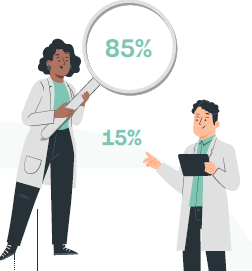
Traditionally, the professional group of nurses is composed mainly of women. Belgium has about 85% female nurses. This percentage has been stable for many years. The age pyramid shows an even distribution of nurses by age.
|
 |
Number of nurses active in health care by age and gender (2022)
Most nurses have an employment status of employee (81%) and mainly work in a hospital. The density regarding nurses working in the health sector is slightly higher in the Flemish Community (117.3 per 10,000 inhabitants) than in the French Community (111.5 per 10,000 inhabitants).
Professional status of nurses active in health care, 2022
Percentage of nurses active in health care, 2022
 |
To meet the increasing demand for care, a stable and annual increase in the number of nurses in the healthcare system is necessary. Until 2019, Belgium experienced a steady growth in the number of nurses active in the healthcare system. Since 2020, however, that growth has stalled, resulting in a decrease in the density of the number of nurses. In the forecast, we observe an increase until 2043.
Evolution of the number of active nurses in health care by individual and full-time equivalent from 2004 to 2022
and projections to 2043
In its State of the World's Nursing 2020 report, the World Health Organization (WHO) points to a global shortage of nearly 6 million nurses, concentrated mainly in low- and middle-income countries. But even in higher-income countries, such as Belgium, the aging population and increased pressure on the healthcare workforce pose major challenges to healthcare capacity.
Learn more?
https://www.who.int/publications/i/item/9789240003279
 |
“Stagnating growth in the number of nurses requires revision of the care model" |
The WHO stresses that it is no longer feasible to cope with the increasing demand for care purely through further expansion of the workforce. Structural and innovative solutions are pressing. Alternatives such as an overhaul of the health professions, reorganization of work, and reliance on task shifting and task sharing are becoming necessary.
In this context, the nursing profession is also undergoing a reorganization in Belgium. Tasks are being rearranged between care providers, with the goal of providing the right care by the right person at the right time. These reforms offer opportunities to use available capacity more efficiently, monitor the quality of care and make the profession more attractive to (future) caregivers.
|
Reform of the nursing profession and practice
These new roles offer greater career advancement opportunities and make the profession more attractive to both current and future healthcare workers. The definition of the practice of the nursing profession was also modernized. The new definition better reflects the reality of practice and leaves room for further evolution. Nurses responsible for general care are given more autonomy: they are now allowed to perform certain technical acts without medical prescription. Since 2024, certain technical acts may also be performed by people without a degree for nurses, within two different frameworks:
Nurses play a central role here: they may train and authorize these skilled helpers to perform certain care tasks. This not only lightens their own workload, but also ensures that people in sectors such as disability, education or child care can receive the necessary care without having to be admitted to a care facility due to a shortage of nursing staff. Soon it will also be legally possible to delegate nursing actions to other health care professionals, within a structured care team and under the supervision of the nurse responsible for general care. These reforms are an important step forward. They provide more recognition, more growth opportunities and a better division of labor within the health care system. Thus, together we are building a stronger, more modern and attractive nursing profession. In order to address these reforms in a scientifically based manner, there remains a need to monitor relevant figures for Belgium. Therefore, the evolution of the number of nurses will be further mapped and indepth analyses will be carried out. In doing so, attention will be paid to the mobility of nurses within and outside the healthcare sector. This analysis will also take into account different types of outflow, including retirement, disability and emigration abroad. More figures on nurses? |
A recent study conducted by IDEA provides in-depth insights into the experiences and career paths of nurses in Belgium and builds on previous reports and scenarios on the labor market position of nurses.
The study shows that nurses often face a high workload, limited career advancement opportunities and a lack of recognition. Many nurses leave the profession or transfer to other sectors, in part because of the difficult work-life balance. Symptoms of burnout are frequent, indicating a need for better support and welfare policies. The attractiveness of the profession is under pressure, which requires urgent policy measures to strengthen the entry, retention and motivation of nurses.
Learn more?
https://overlegorganen.gezondheid.belgie.be/nl/documenten/hwf-studie-over-deactiviteiten-
loopbaan-en-professionele-ontwikkeling-van
[1] Coordinated Act of May 10, 2015 on the practice of health professions, article 46§1. Accessed at https://www.ejustice.just.fgov.be/eli/wet/2015/05/10/2015A24141/justel
- Details
General
In 2021, there were 11,819 professionals authorized to practice the profession of "dental specialist" in Belgium. Among them, 65% are active in health care (or 7,695 dentists), 8% are active outside health care, 11% do not work in Belgium and 16% are retired. Of these healthcare dentists, 52% are active in the Flemish Community and 48% in the French Community.
Percentage of dentists by activity status and community (2021)
Most dentists have an employment status of only self-employed (97%).
The density of dentists active in health care per 10,000 inhabitants in Belgium varies according to the districts, with, for example, low density in Hainaut and high density in Walloon Brabant; the density is higher in the Brussels Capital Region (9.9) than in the other regions (7.3 in the Flemish Region; 6.7 in the Walloon Region).
Number of active dentists per 10,000 inhabitants by district of activity (31/12/2021)
Based on historical data, future scenarios were developed that study the evolution of the relationship between the supply of dental care and the healthcare needs of the Belgian population, under unchanged conditions and policies with projections up to 2046.
The graphs below show the evolution of dental care needs and supply of care in Belgium.
- The need for care is estimated on the basis of population growth and structure, weighted according to
the consumption of dental care reimbursed by the NIHDI (= weighted population). - The care supply refers to the evolution of the number of active general dentists (=number of individuals
and their full-time equivalents (FTE) within the health care system).
Both evolutions are shown by community as a percentage increase from the 2021 baseline year.
General dentistry - Flemish community Percent change from 2021
General dentistry - French Community Percent change from 2021

For both communities, we find that the supply of dental care by general dentists will increase between 2021 and 2046.
- In the Flemish Community, there will be a slight decrease in supply between 2021 and 2026, followed by
a gradual increase until 2046. Moreover, the Belgian population's demand for dental care will increase
until 2046. The ratio of care supply to care demand observed in 2021 will be less favorable until 2031,
but will improve from 2036 thanks to a stronger increase in the supply of general dentists. - In the French Community, the supply of dental care by general dentists will remain at approximately the
same level between 2021 and 2036 and then increase until 2046. The need for dental care will increase
by 2% between 2021 and 2026 and then remain relatively stable until 2046. The relationship between
supply and demand for care observed in 2021 will be less favorable until 2036, but will improve from
2041 thanks to a stronger increase in the supply of general dentists.
In the age pyramid of general dentists active in healthcare in Belgium for 2021 and 2031 below, it can be seen that the older, more male workforce is slowly giving way to a younger, more female workforce.
Prospective number of general dentists by age and gender
In addition to these changes in the composition of general dentists, between 2021 and 2046, the proportion of general dentists with a non-Belgian nationality (regardless of the country in which they obtained their degree) will also increase significantly:
- from 5% to 10% in the Flemish Community.
- from 15% to 24% in the French Community.
Periodontology and orthodontics
With unchanged conditions and unchanged policies, the number of dental specialists in periodontology and orthodontics active in health care will increase significantly between 2021 and 2046. The demand for periodontal care will also increase between 2021 and 2046. In addition, a decrease in the need for orthodontic care is expected, mainly related to the future decline in the young population. This is the main target population for orthodontic treatment.
The socio-demographic composition of dental specialists in periodontology and orthodontics will also change between 2021 and 2046.
- Within periodontology, an increasing evolution of older dentists and dentists of non-Belgian nationality
(regardless of the country where they obtained their degree) is expected. - Within orthodontics, the evolution shows more differences between the communities. In both
communities, a decrease in the proportion of female dentists and an increase in the proportion of
dentists of non-Belgian nationality is expected. While in the Flemish Community there is a rejuvenation
of the workforce, in the French Community an aging of the workforce is rather expected.
More figures on dentists?
• Dentists in the labour workforce: https://overlegorganen.gezondheid.belgie.be/nl/documenten/
hwf-tandartsen-op-de-arbeidsmarkt-2017-2021
• Base case: https://overlegorganen.gezondheid.belgie.be/nl/documenten/hwf-tandartsen-de-workforce-2046-basisprojectie-uitgaande-van-de-reele-instroom-tot-2022