
1. Key messages
- The Commission Healthcare Objectives of the National Institute for Health and Disability Insurance (NIHDI) defined eight evidence based healthcare objectives to guide Belgian health policy in the coming parliamentary term.
- Five priority healthcare objectives were identified:
- Improve collection and exchange of data, both at the macro level to inform health policy and at the patient level to support more integrated care.
- Increase efficiency, including by addressing major unexplained variations in medical practices.
- Improve organization of primary care and coordination between different care levels through multidisciplinary care teams and the application of population‑management principles.
- Enhance financial accessibility of care for everyone and reduce unexplained differences in treatment between socioeconomic groups.
- Strengthen efforts in awareness‑raising, prevention, and screening, supported by clearly defined agreements between federal and federated entities.
2. Healthcare Objectives
The Commission for Healthcare Objectives formulated eight healthcare objectives, two of which are transversal and continuously interact with the remaining six. The Commission emphasized that substantial progress on these transversal objectives is essential for achieving the remaining six objectives, which are designated as priority policy domains [1].
Transversal healthcare objectives
- Improve collection and exchange of data, both at the macro level to inform health policy and at the patient level to support more integrated care.
- Increase efficiency, including by addressing major unexplained variations in medical practices.
Priority policy domains
- Improve organization of primary care and coordination between different care levels through multidisciplinary care teams and the application of population‑management principles.
- Strengthen person‑centered care and elevate patient involvement based on their life goals, combined with improving the population’s health literacy.
- Enhance financial accessibility of care for everyone and reduce unexplained differences in treatment between socioeconomic groups.
- Reform healthcare professions by breaking down rigid divisions between formal qualifications, while ensuring sufficient attention to the well‑being of healthcare professionals.
- Strengthen efforts in awareness‑raising, prevention, and screening, supported by clearly defined agreements between federal and federated entities.
- Focus on sectors where multiple challenges converge: dental and oral care, and mental healthcare.
Out of these eight objectives, the Committee selected five priority healthcare objectives: 1, 2, 3, 5 and 7.
3. Governance & Roadmap
At the proposal of the Minister of Social Affairs and Public Health, Frank Vandenbroucke, a Commission for Healthcare Objectives was established within the NIHDI in 2024. The task of this Commission is to provide scientific guidance for healthcare policy for the upcoming parliamentary term and to evaluate and, if necessary, update these orientations in preparation for the annual healthcare budgets [2].
The commission is composed of representatives from the academic and scientific community (e.g., universities, Sciensano, Federal Knowledge Centre for Health Care (KCE), the Superior Health Council) as well as from healthcare institutions (health insurance funds, professional associations of healthcare providers, NIHDI, Federal Public Service Finance (FPS), Public Health, Federal agency for medicines and health products (FAMHP)).
The Commission’s healthcare objectives are designed to guide concrete actions in the healthcare system. They aim to implement the specific healthcare objectives through targeted interventions in care processes and care structures. They contribute to achieving the broader interfederal health objectives and ensure that the healthcare system can fulfil its central role as effectively and sustainably as possible in order to improve the health of the entire population [3].
The formulation of these healthcare objectives was based on existing scientific evidence regarding the relationship between characteristics of the healthcare system and care processes on the one hand, and the outcomes related to the Quintuple Aim objectives on the other [1].
Quintuple Aim objectives:
- Improving the quality of care at the individual level.
- Improving population health.
- Pursuing cost‑effectiveness.
- Promoting inclusiveness and equity - ensuring broad accessibility.
- Improving the well‑being of healthcare professionals.
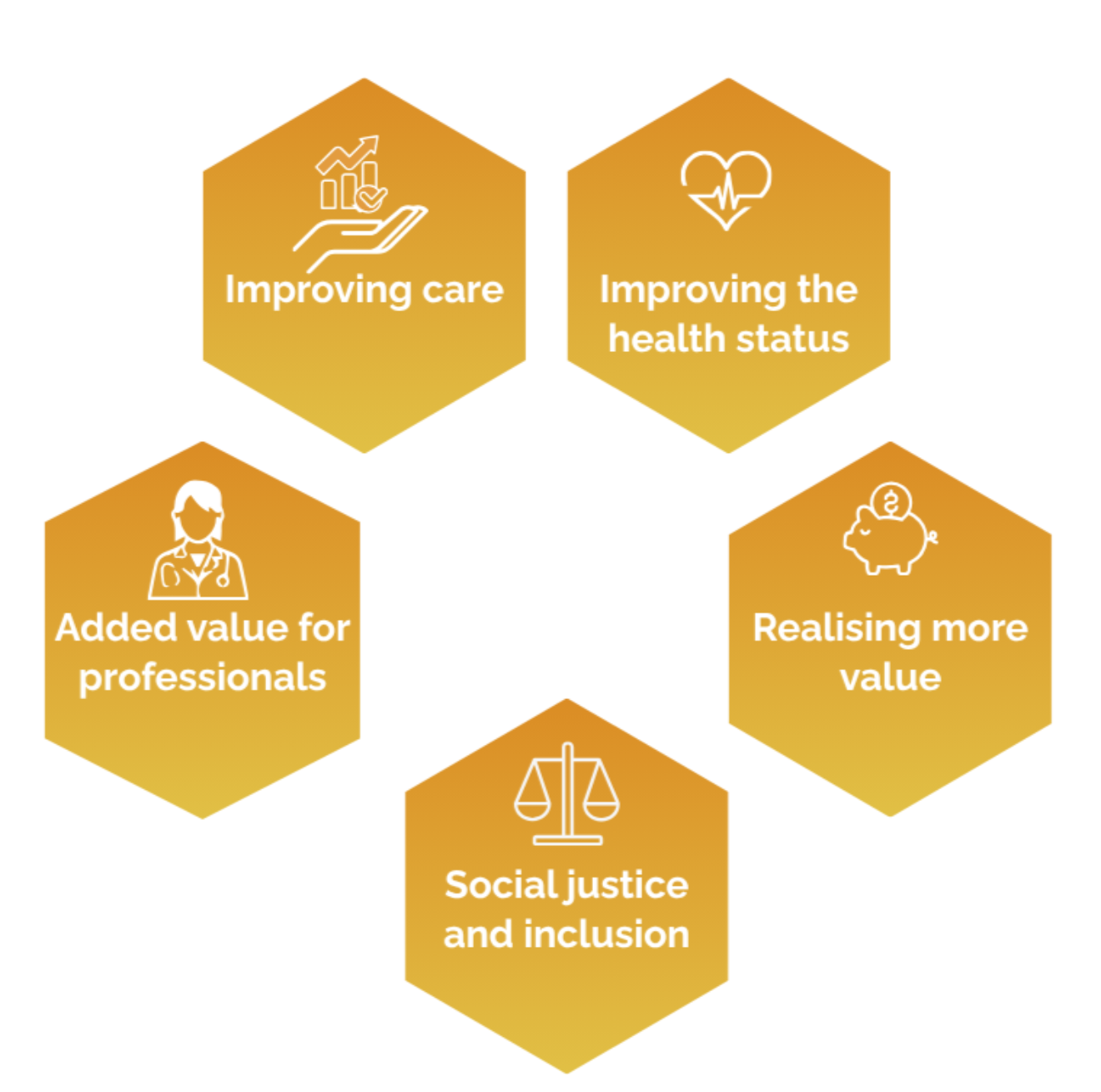
Building on these principles and values, the health care objectives were established by identifying the priority areas to improve the Belgian health care system. They were informed by key insights from the project “Multiannual Budget for the Health Insurance System 2022–2024” [4] and the health system performance assessment report [5]. These priorities were discussed by the Commission and grouped into specific policy domains, resulting in the formulation of the eight healthcare objectives.
In addition, the Commission identified several important areas of concern that receive less attention in the current scientific literature, particularly the ecological sustainability of the healthcare system and the care for rare diseases [1].
The Commission of Healthcare Objectives published its advisory report in June 2026. The report builds on the five priority healthcare objectives established by the NIHDI for the current legislative term. It provides a concrete action framework, including specific sub-objectives and guiding indicators [6].
For each of the five priority healthcare objectives, a dedicated working group was established. During the 2025–2026 working year, these groups met to develop their recommendations for the NIHDI. Sciensano led the Prevention Working Group (Healthcare Objective 7). This group prepared an additional report outlining the technical background to the recommendations submitted to the NIHDI. The report provides an overview of the current prevention landscape in Belgium, identifies the main challenges and opportunities to strengthen primary, secondary and tertiary prevention within the healthcare sector, and highlights the importance of inter-federal collaboration, data sharing and the role of the NIHDI in this context [6].
4. References
- RIZIV/INAMI. Advies gezondheidszorgdoelstellingen aan de Algemene Raad van het RIZIV. https://www.riziv.fgov.be/nl/pers/advies-gezondheidszorgdoelstellingen-aan-de-algemene-raad-van-het-riziv
- Wetsontwerp houdende een meerjarenkader en gezondheidszorgdoelstellingen. 2023. https://etaamb.openjustice.be/nl/wet-van-06-november-2023_n2023046942
- IMC Public Health. Interfederal Health Objectives – Status Report 05/11/2025. Brussels. 2025.
- RIZIV/INAMI. Meerjarig begrotingstraject voor de verzekering voor geneeskundige verzorging 2022-2024. 2022. https://www.inami.fgov.be/SiteCollectionDocuments/rapport_werkgroep_quintuple_aim_meerjarenbegroting.pdf
- Gerkens S, Lefèvre M, Bouckaert N, Levy M, Maertens de Noordhout C, Obyn C, et al. Performance of the Belgian health system: Report 2024. 2025. doi:https://doi.org/10.57598/R376C
- Report of the Commission Healthcare Objectives June 2026 (PDF)
- Vanrumste H, Hemeryck J, Schmidt M, De Pauw R, Devleesschauwer B. Prevention in the Belgian Healthcare System: Context, Challenges and Opportunities. A Synthesis of Expert Exchanges within the GDOS/COSS Prevention Working Group (2025–2026). Sciensano; 2026. doi: 10.25608/C4FM-WC85
Please cite this page as: Sciensano. Healthcare Objectives, Health Policy Monitor, 10 June 2026, Brussels, Belgium.