
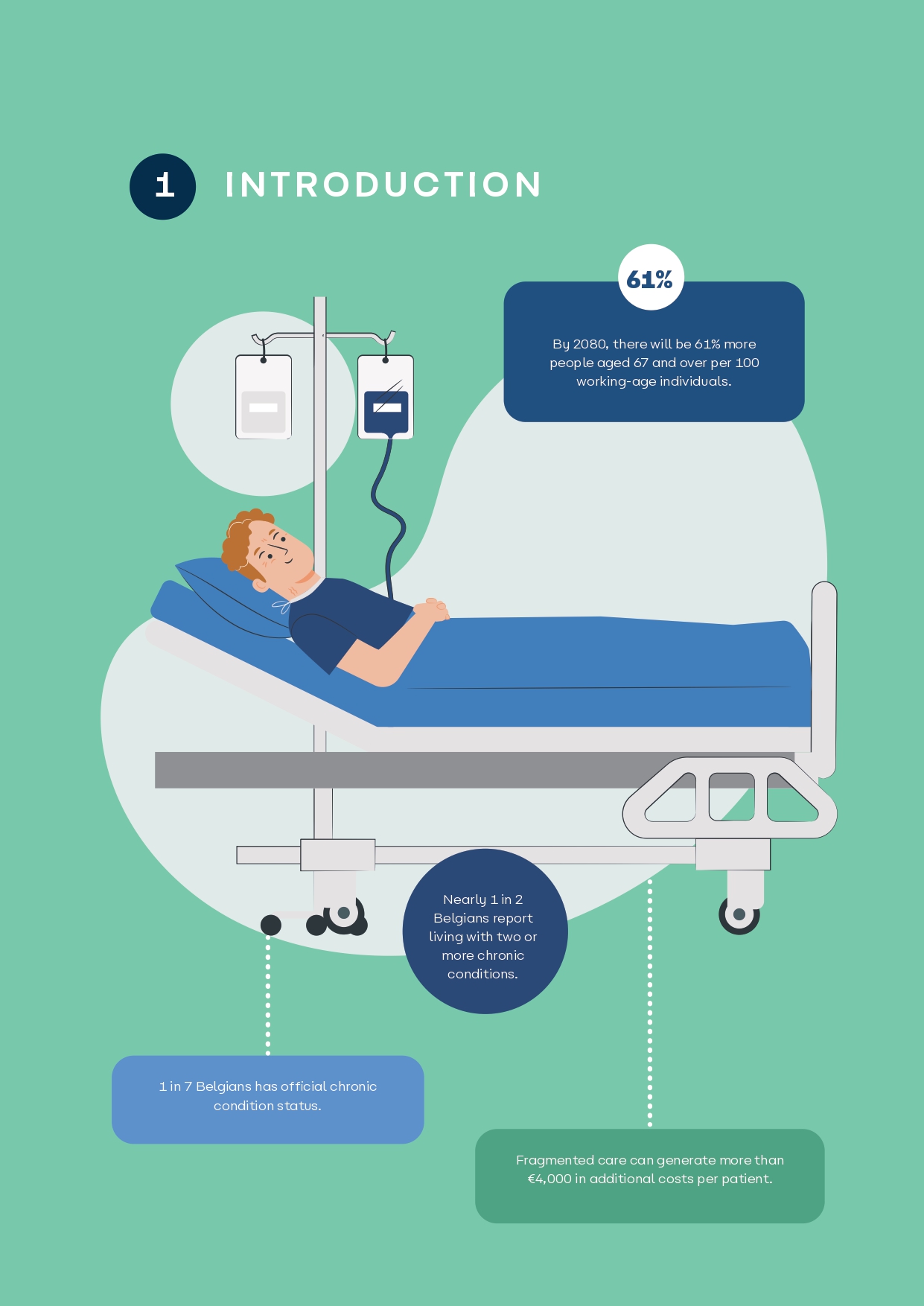
The Belgian healthcare system is evolving within a changing context. Our population is ageing and more and more people are living with one or more chronic diseases. The number of people aged 67 or over is increasing, compared to size of the working-age population. In 2080, for every 100 people aged 18 to 66, projections show that 45 people will be aged 67 or over; in 2025, that figure was 28.[1] In addition, 48% of Belgium’s population aged 15 or over report having had two or more chronic illnesses in the past 12 months. These are primarily older adults who have two or more chronic conditions, but in recent years, there has been a notable increase amongst people aged 25 to 64.
Trends in the percentage of the population aged 15 or over who report having had two or more chronic
conditions in the past 12 months (2013–2023/2024)
These figures from the Belgian Health Survey (2013-2024) are based on self-reporting. The available objective information about chronic illnesses in Belgium is often limited to certain conditions. We do know that the greatest ‘burden of disease’ is caused by musculoskeletal disorders such as lower back pain, mental disorders and cancers [2] and that approximately 15% of Belgium’s population has the chronic condition status – a status granted to eligible individuals when their healthcare expenses exceed a certain threshold.[3]
These developments are leading to increasingly complex healthcare needs, while healthcare services are under pressure due to staff shortages and high workloads. Furthermore, the healthcare system in Belgium has historically been organised in a fragmented manner across various sectors and professional groups, which has helped create its current structure and operation. This sometimes makes it difficult for patients to understand their care pathway and for healthcare and social service providers to work together smoothly. This fragmentation also leads to additional costs: according to analyses, these can amount to more than 4,000 euros per patient.[4]
At the same time, digitalisation and innovative technologies in healthcare are opening up new opportunities. For example, digital tools make it possible to share information more effectively amongst healthcare and social service providers, to monitor health metrics more closely and to organise care more efficiently. Efforts to promote digital skills and boost the creation of interoperable digital infrastructure are necessary in order to achieve this.
Something else that is changing, is the patient’s role. We are moving from a situation where patients are more ‘passive’ recipients of care to one in which they are more informed recipients and ‘co-decision-makers’ within the care and support process. This calls for a different approach to collaboration, in which healthcare and social service providers, patients and their support networks make decisions together, plan together and work together to provide goal-oriented care.
All of these developments underscore the need for integrated care. This means that various healthcare and social service providers coordinate their efforts, and that the person concerned is a partner within the care process. It’s not just about medical care, but also about assistance with daily activities, social support and the involvement of informal caregivers.
Based on the World Health Organization’s framework,[5] we can define integrated care as:
“An approach to strengthen people-centred health systems through the promotion of the comprehensive delivery of quality services across the life course, designed according to the multidimensional needs of the population and the individual and delivered by a coordinated multidisciplinary team of providers working across settings and levels of care. It should be effectively managed to ensure optimal outcomes and the appropriate use of resources based on the best available evidence, with feedback loops to continuously improve performance and to tackle upstream causes of ill health and to promote well-being through intersectoral and multisectoral actions.”
In simple terms, integrated care for an individual can mean the following:
“I can plan my care with people who work together, understand me and help me get the care that’s most important for me.”
In this edition of Key data in healthcare, we show how integrated care is being implemented in Belgium and how this approach can contribute towards an accessible, cohesive and more future-proof healthcare system in Belgium.
[1] Source: 1992–2024: observations, Statbel; 2025–2080: projections by FPB and Statbel. Retrieved from https://statbel.fgov.be/nl/themas/ bevolking/bevolkingsvooruitzichten#news
[2] Sciensano. Burden of disease: Disability-Adjusted Life Years, Health Status Report, 26 June 2025, Brussels, Belgium, https://www. healthybelgium.be/en/health-status/burden-of-disease/disability-adjusted-life-years
[3] Source: http://www.ima-aim.be
[4] OECD (2023), Integrating Care to Prevent and Manage Chronic Diseases: Best Practices in Public Health, OECD Publishing, Paris, https://doi. org/10.1787/9acc1b1d-en.
[5] WHO Regional Office for Europe. Strengthening people-centred health systems in the WHO European Region: framework for action on integrated health services delivery. 2016 https://iris.who.int/bitstreams/6eb1da76-189c-4bbd-ac79-62523037ffae/download