
Evaluating integrated care is complex because it has various effects (e.g. clinical, social, financial and organisational). The quintuple aim, which was explained in Chapter 2, serves as a guide in the evaluation of integrated care.
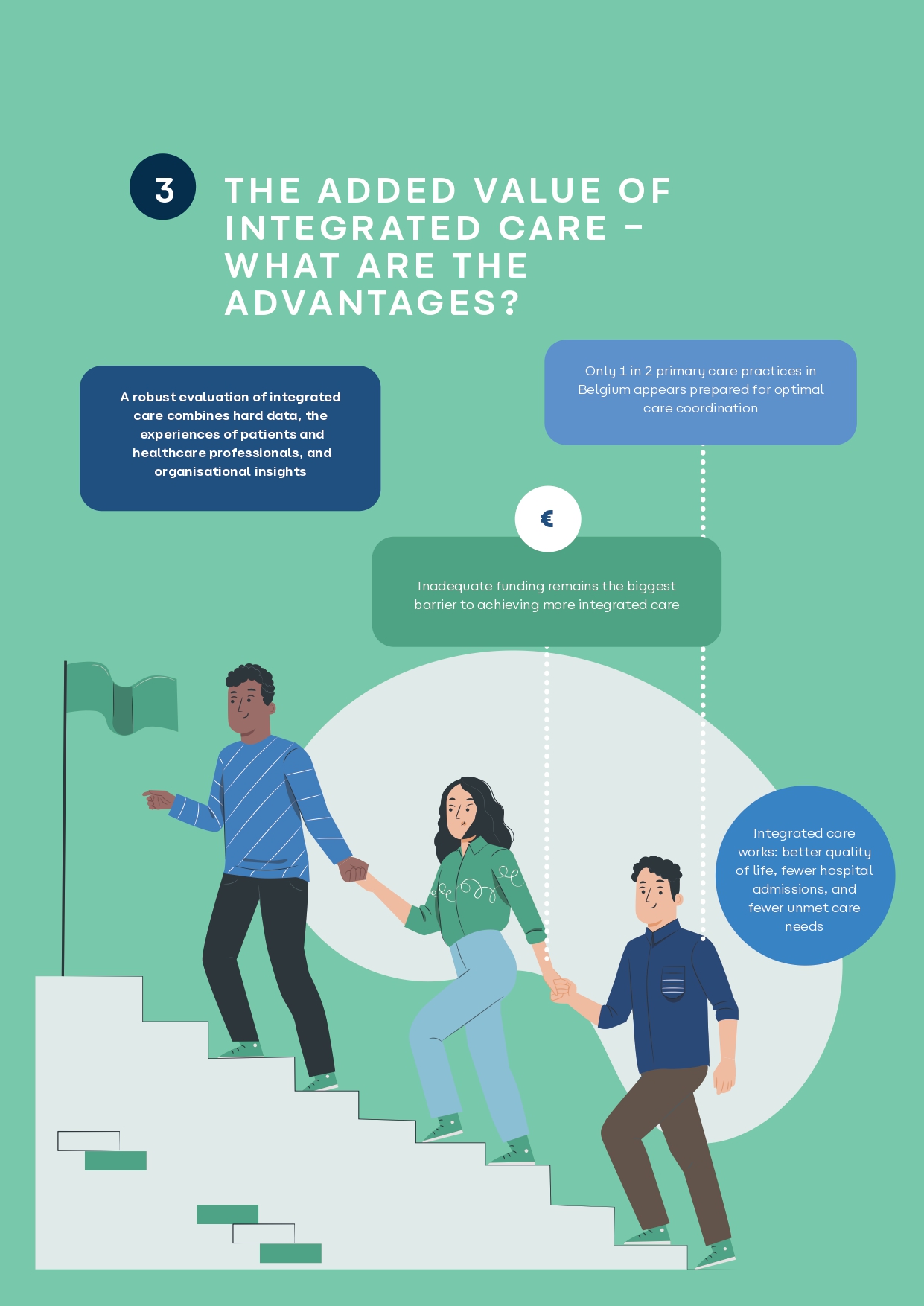
Patient outcomes (e.g. in terms of health outcomes and satisfaction) are often used to help demonstrate the added value of integrated care. The effects of integrated care programmes on care utilisation (such as the number of emergency admissions) or organisational effects (such as changes in collaboration between healthcare and social service providers, the drawing up of care plans) are also frequently measured. A thorough evaluation of integrated care brings together hard data, the experiences of patients and healthcare and social service providers, and organisational insights.
However, the Handbook of Integrated Care[1] emphasises that evaluating integrated care as a comprehensive package is difficult, if not impossible. Integrated care has a broad definition and there are many (external) factors that contribute to its success. Furthermore, data is often fragmented because information from different healthcare and social service providers or organisations needs to be extracted from different systems and combined. It is recommended to first measure the impact of key elements that help achieve integrated care, such as strengthening primary care, transmural care, targeted care, proactive screening, or care coordination. The WHO identified five strategic directions relating to person-centred and integrated care: empowering and engaging people, strengthening governance and accountability, reorienting the model of care, coordinating services and creating an enabling environment. [2]
3.1 International evidence

The available international evidence regarding integrated care in terms of accessibility and continuity of care in primary care, hospital utilisation and patient outcomes and experiences is clearly positive. A meta-review of 27 systematic reviews found that the majority of the reviews reported that integrated care had resulted in positive effects, such as a reduction in the number of hospital admissions and readmissions, improved patient adherence to treatment and an improvement in perceived quality of life.[3]
As far as the financial implications are concerned, less evidence is available to suggest that the implementation of integrated care leads to a reduction in costs. Integrated care requires a cultural shift on the ground and initially, additional resources are often needed in order to bring about this change. A reduction in costs was primarily observed in studies that lasted longer than one year.[4]
In the United States, significant cost savings were observed within “Accountable Care Systems”[5].“Accountable Care Systems” are groups of doctors, hospitals and other healthcare providers that enter into an agreement with a health insurance plan and work together to provide coordinated, high-quality care to the plan’s members. The cost savings achieved by providing coordinated, high-quality care are distributed amongst the various partners concerned. In this way, healthcare providers are paid not only for the care they provide to patients but also for the proactive care they provide to prevent illness, complications or relapse.
Examples of cost savings in Europe have already been recorded in Europe as well. In Germany, the “Gesundes Kinzigtal” approach to integrated care resulted in cost savings, without compromising the quality of care provided. This encourages healthcare providers to improve prevention and care coordination, and the cost savings (shared savings) are also distributed amongst the healthcare providers involved. [6]
3.2 National evaluation initiatives

In Belgium, too, efforts to evaluate integrated care have already been under way for years.
The 2022 KCE study (see before) examined the level of maturity of integrated care in Belgium as perceived by professionals in the field.[7] However, this study showed that, according to the professionals surveyed, integrated care in Belgium is still in its infancy. The professionals identified the healthcare system’s current funding mechanisms as the main barrier in that regard. Performance-based funding does not encourage interdisciplinary, person-centred or health-centred practices. However, the KCE’s patient surveys have in fact shown that more than 60% of respondents are satisfied with the way that healthcare is organised in Belgium. On the other hand, the majority of respondents indicated that they were (almost) never asked about their own goals or about any side effects they experienced during the care and support process. Many also received only limited information or treatment options. This suggests that the respondents experienced little integrated care.
Another initiative that sought to gather patients’ experiences with integrated care is the Patient-Reported Indicator Survey (PaRIS).[8] PaRIS is an international initiative of the Organisation for Economic Cooperation and Development (OECD), in which Belgium participates. The study focuses on what has been missing from healthcare systems until now: systematic data on the extent to which the primary care provided meets the needs of people with chronic conditions. The study uses questionnaires to collect data on the experiences and health outcomes of individuals with chronic conditions who are over 45 years of age and have had at least one visit to a primary care physician in the past 6 months. The study therefore gives a voice to people with chronic conditions, which should enable both policymakers and healthcare and social service providers to improve the quality of our care.
The 2025 PaRIS study shows that countries differ greatly in terms of how well people with chronic conditions are able to use digital health information, how care is coordinated and how many people with chronic conditions are involved in their own care. Experiences and health outcomes also appear to vary, depending on a person’s socio-economic status, sex and the number of health conditions involved. The results encourage countries to align their healthcare systems more effectively to the needs of people with chronic conditions, while learning from successful examples in other countries.
In Belgium, 59 general practices took part in the study and a total of 4,687 completed questionnaires were analysed. The results of the study from Belgium show that:
-
more than 95% of respondents in Belgium reported receiving high-quality healthcare
-
more than two thirds of respondents in Belgium feel that their care is well coordinated, although only a small group indicated that the coordination taking place between healthcare providers was good. This often leads to delays or repeated tests.
-
Individuals with chronic conditions who have a care plan (“A written agreement between a person and his or her care provider that specifies the type of care to be provided over a longer period, how that care will be organised and what responsibilities the person will assume in managing his or her own care.”) experience a higher degree of person-centred care. However, it was found that care planning is not standard practice.
-
Less than half of the respondents said they always received enough information whenever they needed it in order to manage their own health and well-being.
Below are some key figures from the PaRIS study for Belgium, compared to the OECD average:
Perceived quality of primary care amongst individuals with at least one chronic condition, based on four indicators
(comparison between Belgium and the OECD)
|
In addition to people with chronic conditions, the participating general practices themselves were also surveyed. That survey shows that less than half of the participating primary care practices were well prepared to coordinate care effectively. Furthermore, the involvement of non-physicians in long-term care, at 46%, remains limited, compared to the OECD average of 83%. Patient experiences aren’t just about numbers; they’re also about listening to people’s stories. Below is a patient’s testimonial about his experiences with integrated care as part of an integrated care project for older adults, which included occupational therapy, psychological support and case management. |
 |
|
Patient testimonial “Ever since I enrolled in the NIHDI’s integrated care programme for older adults [9], my life has felt a lot easier. The integrated approach has really made a difference in my everyday life. With the help of the case manager – my point of contact – I was able to get in touch with a home help service. The home help, who comes round every Tuesday at around 10 a.m., not only provides practical help but also brings a sense of peace. They do my grocery shopping now that I can no longer drive and they’re happy to take care of my ironing. However, it goes beyond that; their arrival gives me a sense of structure and their presence feels comforting. Sometimes we just have a little chat and that means more than they themselves might realise. Even when my husband was still alive, I could already see how well the healthcare providers worked together. The occupational therapist gave us a clear explanation about assistive devices and taught him how to get in and out of bed more easily. She also arranged for a walker and a wheelchair. Everything was arranged for us. A company came to our house to take measurements, and we didn’t have to worry about a thing. That kind of care, where you feel like they’re really listening to you and suggesting solutions, is worth its weight in gold. Likewise, with the help of the occupational therapist, I was referred to a psychologist, because I needed more than just a listening ear. Since my husband passed away, the psychologist has been coming by every two weeks. I had already known her for a long time, since the time when she was there for my husband during his difficult times and supported me through it all. She listens and gives me tools to cope with my grief. Her visits really do make me happy. I also eat at the neighbourhood restaurant every week. It’s nice to run into people there whom I’ve known since I was a child. After the meal, I sometimes play Uno or cards in the common room. That little bit of social interaction gives me a feeling of warmth and connection. Perhaps what matters most to me is having a single point of contact. It makes me feel safe. I don’t have to tell my story over and over again. My social worker knows what’s going on and refers me to the right person when necessary. I know there’s a strong team behind the scenes that meets regularly to discuss my situation and afterwards, I always get clear feedback – both for myself and my children. That inspires confidence. “The feeling that you’re not in this alone.” |
The PaRIS results show that interdisciplinary collaboration between healthcare and social service providers and the coordination of primary care can still be improved. Below is a testimonial from a psychologist with whom we have already established a fruitful collaboration and built a network.
|
Testimonial from a psychologist “As a self-employed psychologist with a private practice, it’s easy to become isolated and find it difficult to get in touch with the various healthcare and social service providers involved in a case. The local gatherings organised by the mental health network have been a huge help in ‘breaking the ice’. As a primary care psychologist, I have been contacted regularly ever since by the local community health centre and the Public Centre for Social Welfare (PCSW). This kind of collaboration within a local network now happens much more spontaneously and is a breath of fresh air for me. Over the years, we’ve come a long way: from ‘everyone sticking to their own little corner’ to true interdisciplinary collaboration. As a psychologist, I often see young teenagers who come in with their parents at the request of an institution or the parents themselves, even though the teenager has not actually requested help themselves. When a youth centre with a gym asked for our help regarding anxiety, increasing substance use and intrafamilial conflicts, I saw an opportunity to interact with young people within their own space of safety and connect with the things that interest the young people themselves by offering group sessions on-site in collaboration with a youth worker. Thanks to the group-based dynamic, which was perceived as supportive, there was clearly less individual resistance, and the young people proactively shared ideas with one another about resilience. During initiatives of this type, we pay close attention to what is happening within the group, as well as to how each individual participant responds. Some young people then spontaneously ask for individual guidance. We reach out to other young people ourselves in order to suggest an individualised programme.”
|

In summary, we can say that integrated care offers potential benefits for patients and their families, for healthcare and social service providers, for the healthcare system and for society as a whole. In Belgium, the organisation and added value of integrated care are primarily assessed by the competent authorities at macro level (KCE, Sciensano), but also by scientific experts and practitioners by measuring patient satisfaction, perceived coordination and collaboration amongst healthcare and social service providers and outcome measures (and, to a lesser extent, cost savings) for specific populations. In the future, efforts will continue to identify indicators that best reflect ‘good integrated care’ and for which high-quality data can be collected.
[1] E. Nolte, Evidence supporting integrated care, editors V. Amelung, V. Stein, E. Suter, N. Goodwin, E. Nolte, R. Balicer (Eds.), Handbook integrated care, Springer International Publishing, Cham (2021), pp. 39-52
[2] World Health Organization. (2015). People-centred and integrated health services: An overview of the evidence. Interim Report. Geneva: World Health Organization.
[3] Nahara Anani Martínez-González, Peter Berchtold, Klara Ullman, André Busato, Matthias Egger, Integrated care programmes for adults with chronic conditions: a meta-review, International Journal for Quality in Health Care, Volume 26, Issue 5, October 2014, Pages 561–570, https://doi.org/10.1093/intqhc/mzu071
[4] Rocks, S., Berntson, D., Gil-Salmerón, A. et al. Cost and effects of integrated care: a systematic literature review and meta-analysis. Eur J Health Econ 21, 1211–1221 (2020). https://doi.org/10.1007/s10198-020-01217-5
[5] https://www.advisory.com/daily-briefing/2025/09/09/aco-savings
[6] Healthy Kinzigtal Programme in Germany: case study. Geneva: World Health Organization, Organisation for Economic Co-operation and Development; 2023.
[7] Lambert A-S, Op de Beeck S, Herbaux D, Macq J, Rappe P, Schmitz O, Schoonvaere Q, Van Innis A.L, Vandenbroeck P, De Groote J, Schoonaert L, Vercruysse H, Vlaemynck M, Bourgeois J, Lefèvre M, Van den Heede K, Benahmed N. Transitie naar (meer) geïntegreerde zorg in België – Synthese. Health Services Research (HSR). Brussel: Federaal Kenniscentrum voor de Gezondheidszorg (KCE). 2022. KCE Reports 359As. D/2022/10.273/50.
[8] D. Annaert, R. Ekelson, S. Bensemmane, A. Van Vyve, R. De Schreye. Patient-Reported Indicator Surveys (PaRIS): Insights from Belgium. Focused on people living with chronic conditions. Brussels, Belgium: Sciensano. 2025, June. Report number: D/2025.14.440/15.
[9] https://www.riziv.fgov.be/nl/thema-s/kwaliteitszorg/ouderenzorg/alternatieve-vormen-van-ouderenzorg-projecten