
Guidance for healthcare professionals starts even before their education begins.
This guidance involves monitoring and planning the health care workforce. The general idea is to ensure that the health needs of the population are met by preventing both an excess and a shortage of practitioners in a given field.
What is planning?
Planning the number of practitioners in a health care profession is essential to match the supply and demand for care. This is necessary to ensure the quality of care, the well-being of our practitioners, budgetary sustainability and the effectiveness of health insurance. To this end, the ‘Planning Committee for Health Care Workforce’ was established in 1996. The committee consists of representatives of universities, health insurance funds (Intermutualistic College), healthcare professional bodies, the competent ministers, the Communities, the National Institute for Health and Disability Insurance (NIHDI), and the Federal Public
Service (FPS) Public Health.
Initially, planning was limited to physicians and dentists. Today, planning covers an increasing number of health professions. Like the needs of the population, planning is a dynamic process that is constantly being improved.

Phases of planning
The figure below summarizes the different phases that the "Planning Committee for Health Care Workforce" goes through for each profession.
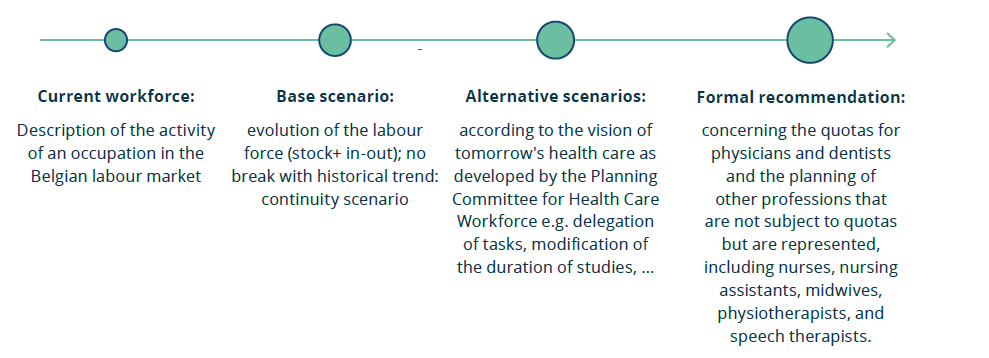
Description of the activity of a profession in the belgian labour market
The registry is very useful to the "Planning Committee for Health Care Workforce" because it provides a record of all persons who have applied for a professional license. However, it is not sufficient to perform all of the committee's tasks.
For example, using the registry, it is not possible to know the number of effectively active professionals and in which sectors or geographical area they are employed.
To make this possible, the "PlanCad" project links data from the cadastre with information from other
sources:
- the National Institute for Health and Disability Insurance (NIHDI)
- the National Social Security Office (NSSO) for data on employees,
- the National Institute for the Social Security of the Self-Employed for the data concerning the selfemployed.
All data are anonymized so that re-identification of individuals becomes impossible. This data link allows in-depth analyses and targeted answers to questions about the composition and activity of the workforce in health professions.
The data is available for several years. This makes it possible to make forecasts regarding the evolution of the workforce. Several future scenarios are developed for each profession.
|
For example:
|
Baseline scenario
The workforce projection model serves as the tool for developing forecasts. It starts from the principle that, for each health profession, there is a demand and a supply.
The demand is determined by the Belgian population in need of healthcare. The supply is determined by the people in the health care profession.
In the baseline scenario, observed historical trends are used as a starting point. Projections are drawn up regarding the evolution of the number of active professionals under a ‘no change in circumstances or policy’ scenario. These projections take into account the existing stock of active professionals, from which outflows (deaths, retirements) are subtracted, while new graduates in Belgium, as well as the inflow of practitioners who obtained their diploma abroad, are added.
The evolution of healthcare demand is estimated based on the number of inhabitants, the population structure by age and gender, and healthcare consumption.
Alternative scenarios
Alternative scenarios are then developed. The parameters of the basic model are adjusted to a number of hypotheses about the future: the working population, the context, activity, the demand for care, and so on. These hypotheses are developed by the various working groups of the "Planning Committee for Health Care Workforce".
Recommendation to the federal minister of Health
|
After the future scenarios have been developed, the “Planning Committee for Health Care Workforce” prepares an advisory report. This recommendation describes the evolution of the profession, the relationship between supply and demand and all related issues and problems. For professions subject to a To date, such a quota only applies to physicians and dentists.
|
 |