
1. Key messages
- The Interfederal Health Objectives set a shared long‑term ambition for Belgium to improve population health by:
- Increasing healthy life expectancy.
- Reducing health inequalities.
- Ensuring a healthy living environment.
- The 2020 federal agreement established long-term health objectives and a monitoring system, developed collaboratively with regional governments and healthcare stakeholders. In 2024, interfederal health objectives were approved to guide policy, ensuring alignment between federal and regional objectives.
2. Context
The Interfederal health objectives articulate a shared long‑term ambition to improve population health in Belgium. They further aim to increase the overall performance and efficiency of health policy in a broad sense, with attention to the various dimensions of quality of life. These are long‑term strategic objectives [1]. In April 2024, the Interministerial Conference (IMC) on Public Health formally approved these objectives, marking an important milestone in strengthening coordinated health governance across the country [2].
These objectives focus on three interconnected ambitions:
- Increase healthy life expectancy.
- Reduce health inequalities.
- Ensure a healthy environment.
Improving population health cannot be achieved through healthcare system performance alone. Progress requires both a One World One Health approach and a Health in All Policies approach. The One World One Health approach brings together human, animal, plant, and environmental health as interconnected parts of the same system [3]. The Health in All Policies approach ensures that sectors such as environment, education, labour markets, housing, income support, mobility, and agriculture are actively involved because their policies strongly shape health outcomes [4].
3. The Interfederal health Objectives
Goal 1 - Increase healthy life expectancy
| Priority disease groups |
| Mental disorders (including substance-related disorders) |
| Cancer |
| Cardiovascular diseases |
| Chronic respiratory diseases |
| Musculoskeletal disorders |
| Neurological disorders |
| Communicable diseases |
| Priority risk factors |
| Tobacco |
| Alcohol |
| Dietary habits |
| Drug use |
| Air pollution |
| Lack of physical activity |
Belgium performs moderately on healthy life expectancy and avoidable mortality due to prevention, alongside a high burden of disease [5, 6,7]. Diseases that account for the largest losses in healthy life years are therefore prioritized when monitoring healthy life expectancy. At the same time, modifiable risk factors continue to be major contributors to health loss in Belgium.
Source: Own calculations based on data from IMA, Intego, ERA, HIS, Belgian Cancer Registry and Statbel [1-6]
Goal 2 - Reduce health inequalities
Targeted action is required to narrow gaps in health outcomes and determinants. The following objectives were formulated:
- Determining specific targets per socioeconomic group for each selected priority formulated under health goal 1.
- Reducing inequalities in the financial accessibility of healthcare.
- Raising awareness among care and welfare professionals-particularly first line actors-and providing them with tools to address the issue of health inequalities.
- Reducing inequalities in living conditions (housing costs and conditions, access to green spaces, access to quality food, etc.).
- Identifying the social determinants that have the greatest impact on reducing health inequalities, as well as targeted measures to address them, and promoting an economy of well being.
There is a substantial health gap between the most and least advantaged groups. Socioeconomic inequalities are particularly pronounced in life expectancy and healthy life expectancy, mortality rates, mental health, and risk factors such as smoking, obesity, physical inactivity, and dietary patterns [8,9].
Health inequalities are largely explained by factors outside the health sector. In the European Region of the World Health Organization (WHO), the largest contributions to health inequalities come from income security and social protection (35%), followed by living conditions (29%), social and human capital (19%), health services (10%), and employment and working conditions (7%) [10]. In Belgium, the most pronounced inequalities appear in living conditions, while major data gaps persist for indicators related to income security and social protection - domains that account for the largest share of inequalities at the European level [11].
Goal 3 – Ensure a healthy environment
For Health Goal 3, the following priorities are identified based on scientific evidence:
- Improving air quality, primarily by reducing emissions from transport, industry, housing, and agriculture.
- Reducing environmental noise, primarily noise resulting from road traffic.
- Identifying critical needs in data collection and in the assessment of major environmental health risks, as well as measures to improve these.
Environmental factors play a substantial role in shaping health disparities. In Belgium, exposure to environmental hazards-such as air pollution, noise, suboptimal urban environments, and low‑quality housing continues to pose significant health risks. Research shows that these exposures are unevenly distributed, with urban populations and communities with a lower socioeconomic status facing a disproportionate burden [12].
Estimates from the Global Burden of Disease study identify air pollution by fine particulate matter, nitrogen dioxide, and ozone as the most consequential environmental risk factors[13,14] . In the Belgian context, although air quality has improved markedly in recent years, a considerable share of the population remains exposed to pollutant concentrations exceeding recommended thresholds [12]. Major contributing sectors include energy production and consumption, as well as emissions from transport, industry, housing, and agriculture. Urban areas and low‑income communities are particularly affected, experiencing systematically higher exposure levels. Belgium ranks third among EU‑14 countries in mortality attributable to particulate matter and nitrogen dioxide (Burden of air pollution - For a Healthy Belgium). Air pollution is associated with cardiovascular diseases, chronic respiratory diseases, lung cancer, and diabetes [15].
Noise pollution constitutes another important environmental health risk. Road traffic noise is the dominant source, accounting for an estimated 90% of noise‑related premature mortality [16]. Noise exposure primarily affects health through stress responses and sleep disruption, which can induce inflammation and oxidative stress. These mechanisms increase the risk of adverse outcomes, including cardiovascular and metabolic disorders such as ischemic heart disease and type 2 diabetes. Children and adolescents are especially vulnerable, with noise exposure linked to reduced reading comprehension, behavioural difficulties, and a higher likelihood of overweight [17].
Beyond air and noise pollution, the WHO also identifies limited access to green spaces, waste production, and broader environmental pollution as additional environmental risks relevant to Belgium. These factors are recognized as potentially important contributors to population health. However, they remain difficult to link directly to specific health outcomes [12].
4. Governance & Roadmap
The 2020 federal government agreement established the formulation of long‑term health objectives alongside a monitoring system, developed in collaboration with the federated entities and healthcare stakeholders [18]. To support this process, a technical working group was created, composed of experts from the federal administrations and the federated entities, as well as external experts from Sciensano, the National Institute for Health and Disability Insurance (NIHDI) and the Belgian Health Care Knowledge Centre (KCE) [19].
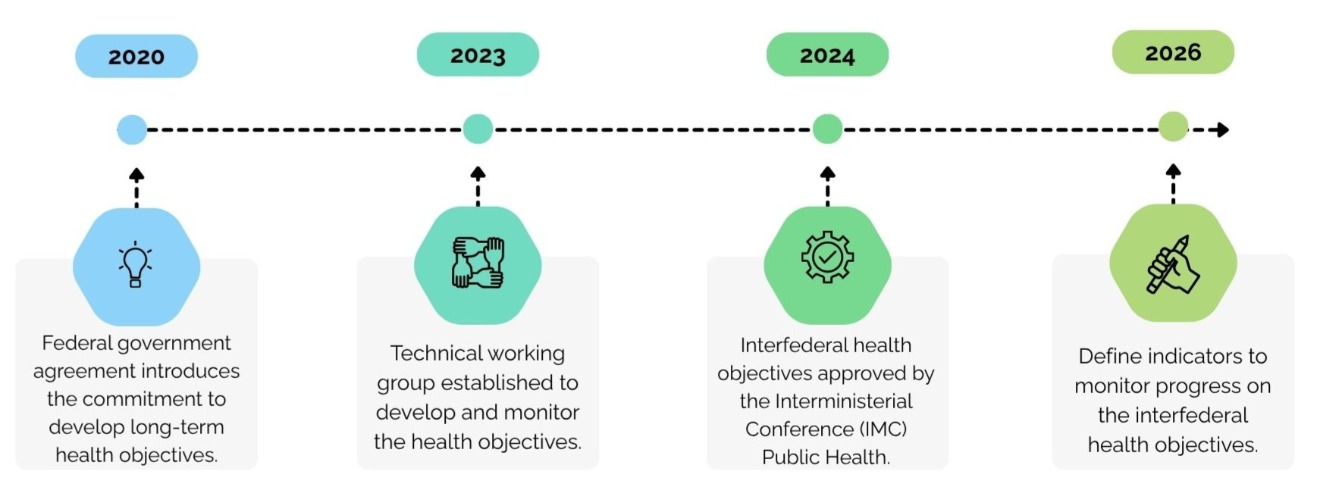
The interfederal health objectives, approved by the IMC Public Health in 2024, serve as an important compass for long‑term health policy. Their development and monitoring require alignment with the health objectives already validated at the level of the federated entities and the federal government. In formulating a minimal set of interfederal health objectives and their monitoring framework, the health goals of the regional governments and the federal government are taken into account. The focus lies on strengthening each other’s competencies and reinforcing the interfederal action plans. This coordinated approach ensures that monitoring is embedded within a broader governance structure [2].
The selection of indicators for the Interfederal Health Objectives was carried out through a Delphi study. Experts from the Belgian health authorities evaluated potential indicators, retaining only those for which consensus was reached. This resulted in 52 indicators, forming the validated basis for monitoring the Interfederal Health Objectives [20].
A policy guided by interfederal health objectives helps to define interfederal priorities while considering existing policies and the competences of the relevant authorities (including both the federated entities and the federal government). It also considers the available budgets and policy priorities at local, regional, and federal levels. Such an approach provides direction for the policies of the involved authorities and supports the implementation and evaluation of interfederal priorities. It also helps identify critical needs in evaluation and data collection by building on existing datasets and assessments. Furthermore, it strengthens synergies across policy domains (Health in All Policies) within and across governance levels, and defines an efficient and ethical framework for cooperation between stakeholders, enhancing the involvement of actors across the health sector [2].
5. Definitions
- One Health approach
- One Health is an integrated, unifying approach to balance and optimize the health of people, animals and ecosystems. It uses the close, interdependent links among these fields to create new surveillance and disease control methods.
- Health in All Policies (HiAP)
- Health in All policies recognizes that population health is not merely a product of health sector programmes but largely determined by policies that guide actions beyond the health sector. Policy in every sector of government can potentially affect health and inequities in health. Using a HiAP approach aims to address policies such as those influencing transport, housing and urban planning, the environment, education, agriculture, finance, taxation and economic development so that they promote overall health and health equity.
- Burden of disease
- The burden of disease is quantified using the Disability-Adjusted Life Year (DALY) metric. The use of DALYs allows to combine the years of healthy life lost due to reduced quality of life (Years Lived with Disability, YLD) and due to premature death (Years of Life Lost, YLL). It therefore permits a truly comparative ranking of the burden of various diseases, injuries and risk factors.
- Multicriteria analysis
- A multicriteria analysis is a structured decision‑making method used to compare and prioritize different options when multiple factors must be considered at the same time. First, assessment criteria should be defined and selected. Then, weights should be assigned to each criterion. Every disease group or risk factor should be evaluated and given a score for each assessment criterion. The final step is to combine the weights and the scores, to calculate the total scores. The highest-ranking scores will be prioritized.
6. References
- RIZIV/INAMI. Advies gezondheidszorgdoelstellingen aan de Algemene Raad van het RIZIV. 2026. https://www.riziv.fgov.be/nl/pers/advies-gezondheidszorgdoelstellingen-aan-de-algemene-raad-van-het-riziv
- FOD Volksgezondheid, Veiligheid van de Voedselketen en Leefmilieu - SPF Santé publique, Sécurité de la Chaîne alimentaire et Environnement. Persmededeling van de Interministeriële Conferentie Volksgezondheid. 2024. https://www.health.belgium.be/nl/nieuws/2024-4-persmededeling-interministeriele-conferentie-volksgezondheid
- European Environment Agency. 2026. One Health. https://www.eea.europa.eu/en/topics/at-a-glance/health/one-health
- World Health Organisation. 2026. Promoting Health in All Policies and intersectoral action capacities. https://www.who.int/activities/promoting-health-in-all-policies-and-intersectoral-action-capacities
- Gerkens S, Lefèvre M, Bouckaert N, Levy M, Maertens de Noordhout C, Obyn C, et al. Performance of the Belgian health system: Report 2024. 2025. doi:https://doi.org/10.57598/R376C
- Sciensano. For a Healthy Belgium. 2022. Life Expectancy and Quality of Life: Health expectancy. https://www.healthybelgium.be/en/health-status/life-expectancy-and-quality-of-life/health-expectancy
- Sciensano. For a Healthy Belgium. 2025. Burden of Disease: Disability-Adjusted Life Years. https://www.healthybelgium.be/en/health-status/burden-of-disease/disability-adjusted-life-years
- OECD. Health at a Glance 2021: OECD Indicators. Paris: OECD Publishing. 2021. https://www.oecd.org/en/publications/health-at-a-glance-2021_ae3016b9-en.html doi:10.1787/ae3016b9-en
- Sciensano. For a Healthy Belgium. 2022. Health Inequalities. https://www.healthybelgium.be/en/health-status/health-inequalities
- World Health Organization. Regional Office for Europe. What is driving the health divide? Factsheet. WHO Regional Office for Europe; 2019.
- WHO Regional Office for Europe. 2026. HESRI products. https://www.who.int/europe/initiatives/health-equity-status-report-initiative/hesri-products
- WHO Regional Office for Europe. Public health review of noncommunicable disease prevention and its determinants: Belgium. Copenhagen; 2023.
- Murray CJL, Aravkin AY, Zheng P, Abbafati C, Abbas KM, Abbasi-Kangevari M, e.a. Global burden of 87 risk factors in 204 countries and territories, 1990–2019: a systematic analysis for the Global Burden of Disease Study 2019. The Lancet. oktober 2020. doi:10.1016/S0140-6736(20)30752-2
- Forouzanfar MH, Alexander L, Anderson HR, Bachman VF, Biryukov S, Brauer M, e.a. Global, regional, and national comparative risk assessment of 79 behavioural, environmental and occupational, and metabolic risks or clusters of risks in 188 countries, 1990–2013: a systematic analysis for the Global Burden of Disease Study 2013. The Lancet. 5 december 2015. doi:10.1016/S0140-6736(15)00128-2
- Sciensano. For a Healthy Belgium. 2025. Burden of disease: Risk factor attributable burden - Burden of air pollution. https://www.healthybelgium.be/en/health-status/burden-of-disease/risk-factor-attributable-burden/burden-of-air-pollution
- Belgium noise fact sheet 2021. 2021. https://www.eea.europa.eu/en/analysis/maps-and-charts/belgium-noise-country-fact-sheets-2021
- European Environment Agency. Environmental noise in Europe: 2025. LU: Publications Office; 2025. https://data.europa.eu/doi/10.2800/9200716
- Government Agreement. Belgian Federal Government; september 2020.
- Interfederal Health Objectives – Status Report. Brussel; november 2025.
- Hemeryck J, Vanrumste H, Devleesschauwer B, De Pauw R. Strengthening Strategic Health Governance: Developing indicators to monitor the Interfederal Health Objectives. Sciensano; 2026. doi: 10.25608/h8a1-k162
Please cite this page as: Sciensano. Interfederal Health Objectives, Health Policy Monitor, 10 June 2026, Brussels, Belgium.