
As healthcare professionals are at the core of the healthcare system, it is crucial to mobilize the necessary resources to strengthen their functions and improve their working conditions over the long term.
We draw attention here to two actions launched with these goals in mind. One relates specifically to the nursing profession, while the other has led to a global reform of healthcare functions.
The Healthcare Personnel Fund
The Healthcare Personnel Fund was established by the adoption of the law of 9 December 2019.[1] Under this law, budgetary resources are made available to improve employment opportunities and support for nurses, and to increase the attractiveness of these professions.
The fund aims to finance the net increase in employment for care personnel, the improvement of working conditions for health care professionals, training and support for mentoring projects.
The costs of support staff who provide relief for healthcare personnel may also be covered by the fund. After all, the support staff is in direct contact with the health care professionals, allowing the latter to spend more time on the actual care of patients.
Overview of the distribution of healthcare staff fund resources
Learn more?
https://www.becaremagazine.be/becare-maart-2022-editie-16/ziekenhuisfinanciering
IFIC
The Institute for Job Classification (IFIC) guides and supports the development and implementation of analytical job classifications, mainly within the healthcare sectors.
The principle of the IFIC is as follows: each sectoral job is described using identical criteria and is assigned to a job category based on the result obtained.
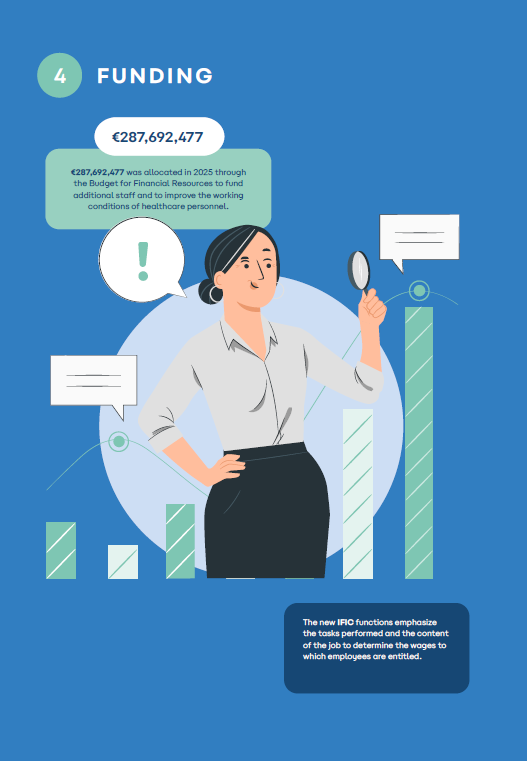
Salary models are attached to these job categories. The new IFIC functions emphasize the tasks performed and the content of the job to determine the salary to which employees are entitled.
Each implementation project is managed on a parity basis. All projects are managed by the social partners (unions and employer federations) of the sectors for which they were developed.
Implementation in the federal private healthcare sectors
Between September 2016 and March 2021, several collective labour agreements were signed to put the new classification and its associated salary model into effect.
Either way, the procedures introduced by the social partners ensure that an employed worker does not lose wages.
Implementation occurred in two phases:
|
1. In phase 1, all employees who were employed on April 30, 2018 received a job assignment and were then given the choice of opting for the new IFIC scale or retaining their pre-existing pay conditions according to their pecuniary benefit for the rest of their careers, with the exception of specialized nurses who receive a premium for a special professional title or ability. Thus, an employee who decided not to join the IFIC system continued to enjoy his or her existing pay conditions, including agreed future increases. All employees hired since May 1, 2018 received their job assignment and the corresponding IFIC scale directly. |
|
2. In Phase 2, starting July 1, 2021, 100% of the IFIC system was implemented; the system now covers all employees in service, always on the understanding that the application of the new pay scales must not in any way result in a loss of pay. Nurses who are accredited for a specific title or qualification and receive a specialization premium, but are not paid according to the IFIC model, maintain their right to this premium as long as they continue to perform nursing duties. |
Application in the federal public health care sectors
Negotiations between the social partners led to the conclusion of four protocol agreements on IFIC in the public sector.
The job classification and corresponding scales are identical in the federal public and private healthcare sectors.
The procedures introduced for rollout in the federal public sector are similar to the application procedures in the private sectors, but have been adapted to the specifics of the public sector. This deals with the assignment of positions to employees and choice of pay scale.
|
Employees in service, who chose the IFIC scale before December 6, 2021, will be compensated according to the new pay scales since July 1, 2021. Employees newly hired since Nov. 9, 2021, will be paid according to the new scales if their position has been activated at the hospital. Non-activated positions are not covered by the new scales. In 2024, the total budget allocated to the federal health care sectors (private and public) amounts to 778,451,000 euros.
|
 |
Meer weten?
https://www.if-ic.org/nl
[1] Act of December 9, 2019 establishing a Healthcare Personnel Fund. Accessed at https://www.ejustice.just.fgov.be/eli/wet/2019/12/09/2019206087/staatsblad