
General information regarding cardiovascular diseases
| In 2023, there were just under 300,000 hospital stays in connection with cardiovascular disease. Looking at the top 10 cardiovascular conditions that led to classic hospitalisation and day hospitalisation in 2023, chronic ischaemic heart disease tops the ranking. Chronic ischaemic disease is a disease of the heart and is caused by arterial calcification or abnormalities in the coronary arteries. Another common reason for admission with cardiac pathology involves cardiac arrhythmias such as atrial fibrillation and atrial flutter. |
 |
Number of stays with a primary diagnosis of cardiovascular disease
Learn more?
https://www.health.belgium.be/nl/mzg-publicaties-Prevalentie-van-ziektebeelden-ineen-ziekenhuis
Care programmes for cardiac pathology
Within the cardiac pathology care programme, several sub-care programmes can be distinguished. Each care programme is characterised by its target population, range of care and interventions, required infrastructure, applicable quality standards, and the required expertise and personnel. Each care programme must meet legally established standards to obtain accreditation.
The highest number of accredited care programmes involves category A care programmes for basic cardiac care and category P programmes involving care for patients with (or in need of) a cardiac pacemaker. It has been found that in the Flemish Region and the Brussels Capital Region, more care programmes have been accredited for invasive cardiac surgery (B3) than for invasive diagnostics combined with interventional, nonsurgical treatment. In the Walloon Region, the opposite is the case. In addition, we observed that accredited care programmes for congenital heart defects in children can only be found in the Brussels-Capital Region and the Flemish Region.
Number of accredited care programmes for cardiac pathology by type and region
Cardiac pathology network
A ‘cardiac pathology’ network makes it possible to offer circuits of care for cardiac pathology patients within a specific geographic area. A circuit of care is a set of care activities tailored to the specific target group of patients.
As a minimum, a ‘cardiac pathology’ network consists of:
- A hospital with a ‘cardiac pathology’ A care programme
- A hospital with a ‘cardiac pathology’ B care programme or with accreditation for B1 and B2 subprogrammes, without B3
- A hospital with a ‘cardiac pathology’ P care programme
- A hospital with a ‘cardiac pathology’ E care programme
- A hospital with a ‘cardiac pathology’ T care programme
- A hospital with a ‘cardiac pathology’ C care programme
- A hospital with a Mobile Emergency Group (MUG/SMUR) function
- A general practitioners’ circle
- A coordinator
- A consultative body
A hospital or healthcare provider can be part of multiple networks for cardiac pathology. Bringing various healthcare providers together should lead to the harmonisation of patient care and an improvement in the quality of healthcare provision.

Circuit of care for acute myocardial infarction with ST-segment elevation
Every cardiac pathology network should offer at least one circuit of care[1] for patients with acute myocardial infarction with ST-segment elevation (STEMI). In 2022, there were 54,048 stays with this diagnosis.[2]
Hyperacute
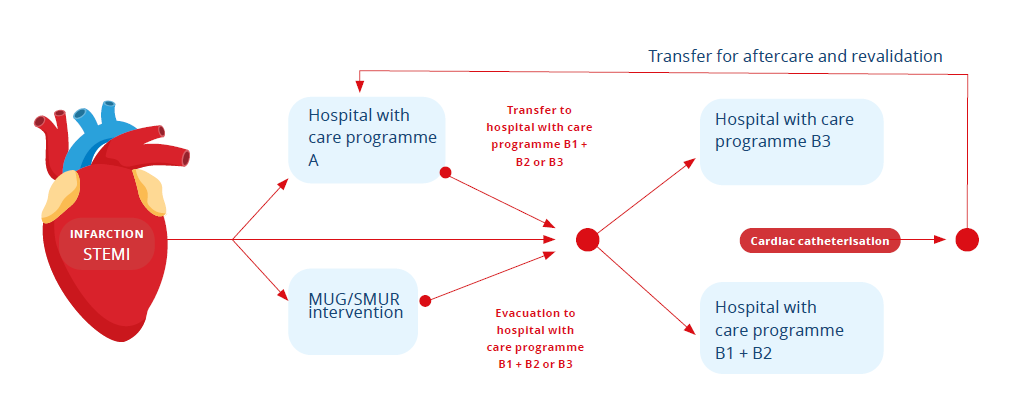
If acute myocardial infarction is suspected, the emergency services should be alerted as quickly as possible. After all, prompt hospitalisation is important because timely treatment increases the chances of recovery. After contact with the Mobile Emergency Group (MUG/SMUR) function, patients are transferred to a hospital accredited for cardiac pathology care programmes B1+B2 or B3. In 2022, 1,456 patients were transported to a hospital accredited for a B3 care programme and 743 were transported to a hospital accredited for a B1-B2 care programme after contact with a Mobile Emergency Group (MUG/SMUR) function.
|
In the emergency department, the diagnosis can be made using an electrocardiogram (ECG). In addition, taking a blood sample will definitely establish the severity of the myocardial infarction. If the patient’s diagnosis was made in a hospital with accreditation for the cardiac pathology A care programme only, the patient must be transferred to a hospital within the network that holds accreditation for care programme B1+B2 or B3. In 2022, 470 patients were transferred to a B3 accredited hospital and 156 patients to a B1 and B2 accredited hospital.
|
 |
Acute
The cardiac catheterisation laboratory is notified of the patient’s arrival at the hospital. In 2022, 27,957 stays were recorded in cardiac catheterisation for coronary conditions. In addition, there were 10,040 stays for percutaneous coronary procedures with acute myocardial infarction.
Recovery and rehabilitation
After treatment, the patient will ideally be transferred again to a hospital with an accredited cardiac pathology A care programme or to one of the 20 approved specialised services for the treatment of cardiopulmonary conditions (S1). The reason for this is so that care can be provided in proximity to the patient’s home environment. 1,087 patients were transferred after a stay in a service with a care programme B to a service with care programme A or an S1 service.
[1] The illustration shows the terms laid down in the Royal Decree of 12 June 2012 concerning the care pathway to be provided in cases of acute myocardial infarction. In addition, however, it is possible that the patient obtains the diagnosis within primary care. For rehabilitation and aftercare, patients can also be transferred to a hospital with accreditation for S1.
[2] Source: FPS Public Health (undated). Technical unit. [Dataset]. These are linked figures from the (Minimum Hospital Data – MZG) and the NIHDI. Here, all stays were selected that were classified in the following APR-DRGs (All Patient Refined Diagnosis Related groups): DRG 190 (Acute myocardial infarction), 191 (Cardiac catheterisation for coronary diseases) and 192 (Cardiac catheterisation for other non-coronary diseases).