
- Details
General information regarding cardiovascular diseases
| In 2023, there were just under 300,000 hospital stays in connection with cardiovascular disease. Looking at the top 10 cardiovascular conditions that led to classic hospitalisation and day hospitalisation in 2023, chronic ischaemic heart disease tops the ranking. Chronic ischaemic disease is a disease of the heart and is caused by arterial calcification or abnormalities in the coronary arteries. Another common reason for admission with cardiac pathology involves cardiac arrhythmias such as atrial fibrillation and atrial flutter. |
 |
Number of stays with a primary diagnosis of cardiovascular disease
Learn more?
https://www.health.belgium.be/nl/mzg-publicaties-Prevalentie-van-ziektebeelden-ineen-ziekenhuis
Care programmes for cardiac pathology
Within the cardiac pathology care programme, several sub-care programmes can be distinguished. Each care programme is characterised by its target population, range of care and interventions, required infrastructure, applicable quality standards, and the required expertise and personnel. Each care programme must meet legally established standards to obtain accreditation.
The highest number of accredited care programmes involves category A care programmes for basic cardiac care and category P programmes involving care for patients with (or in need of) a cardiac pacemaker. It has been found that in the Flemish Region and the Brussels Capital Region, more care programmes have been accredited for invasive cardiac surgery (B3) than for invasive diagnostics combined with interventional, nonsurgical treatment. In the Walloon Region, the opposite is the case. In addition, we observed that accredited care programmes for congenital heart defects in children can only be found in the Brussels-Capital Region and the Flemish Region.
Number of accredited care programmes for cardiac pathology by type and region
Cardiac pathology network
A ‘cardiac pathology’ network makes it possible to offer circuits of care for cardiac pathology patients within a specific geographic area. A circuit of care is a set of care activities tailored to the specific target group of patients.
As a minimum, a ‘cardiac pathology’ network consists of:
- A hospital with a ‘cardiac pathology’ A care programme
- A hospital with a ‘cardiac pathology’ B care programme or with accreditation for B1 and B2 subprogrammes, without B3
- A hospital with a ‘cardiac pathology’ P care programme
- A hospital with a ‘cardiac pathology’ E care programme
- A hospital with a ‘cardiac pathology’ T care programme
- A hospital with a ‘cardiac pathology’ C care programme
- A hospital with a Mobile Emergency Group (MUG/SMUR) function
- A general practitioners’ circle
- A coordinator
- A consultative body
A hospital or healthcare provider can be part of multiple networks for cardiac pathology. Bringing various healthcare providers together should lead to the harmonisation of patient care and an improvement in the quality of healthcare provision.

Circuit of care for acute myocardial infarction with ST-segment elevation
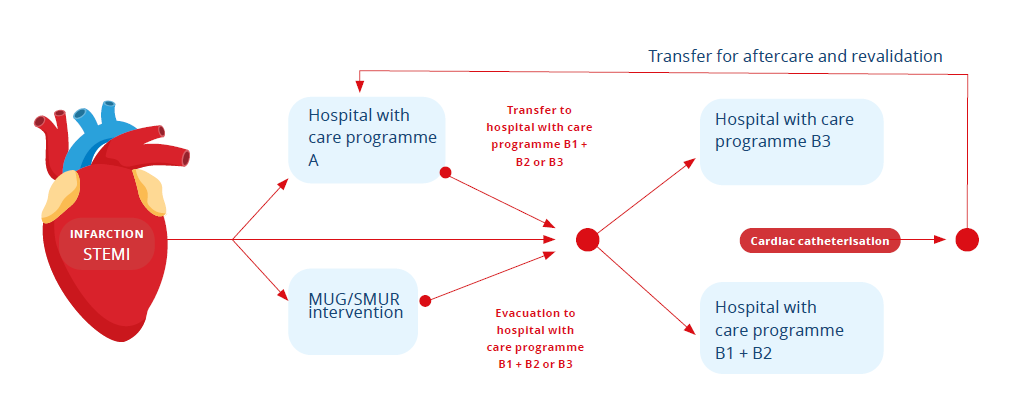
Every cardiac pathology network should offer at least one circuit of care[1] for patients with acute myocardial infarction with ST-segment elevation (STEMI). In 2022, there were 54,048 stays with this diagnosis.[2]
Hyperacute
If acute myocardial infarction is suspected, the emergency services should be alerted as quickly as possible. After all, prompt hospitalisation is important because timely treatment increases the chances of recovery. After contact with the Mobile Emergency Group (MUG/SMUR) function, patients are transferred to a hospital accredited for cardiac pathology care programmes B1+B2 or B3. In 2022, 1,456 patients were transported to a hospital accredited for a B3 care programme and 743 were transported to a hospital accredited for a B1-B2 care programme after contact with a Mobile Emergency Group (MUG/SMUR) function.
|
In the emergency department, the diagnosis can be made using an electrocardiogram (ECG). In addition, taking a blood sample will definitely establish the severity of the myocardial infarction. If the patient’s diagnosis was made in a hospital with accreditation for the cardiac pathology A care programme only, the patient must be transferred to a hospital within the network that holds accreditation for care programme B1+B2 or B3. In 2022, 470 patients were transferred to a B3 accredited hospital and 156 patients to a B1 and B2 accredited hospital.
|
 |
Acute
The cardiac catheterisation laboratory is notified of the patient’s arrival at the hospital. In 2022, 27,957 stays were recorded in cardiac catheterisation for coronary conditions. In addition, there were 10,040 stays for percutaneous coronary procedures with acute myocardial infarction.
Recovery and rehabilitation
After treatment, the patient will ideally be transferred again to a hospital with an accredited cardiac pathology A care programme or to one of the 20 approved specialised services for the treatment of cardiopulmonary conditions (S1). The reason for this is so that care can be provided in proximity to the patient’s home environment. 1,087 patients were transferred after a stay in a service with a care programme B to a service with care programme A or an S1 service.
[1] The illustration shows the terms laid down in the Royal Decree of 12 June 2012 concerning the care pathway to be provided in cases of acute myocardial infarction. In addition, however, it is possible that the patient obtains the diagnosis within primary care. For rehabilitation and aftercare, patients can also be transferred to a hospital with accreditation for S1.
[2] Source: FPS Public Health (undated). Technical unit. [Dataset]. These are linked figures from the (Minimum Hospital Data – MZG) and the NIHDI. Here, all stays were selected that were classified in the following APR-DRGs (All Patient Refined Diagnosis Related groups): DRG 190 (Acute myocardial infarction), 191 (Cardiac catheterisation for coronary diseases) and 192 (Cardiac catheterisation for other non-coronary diseases).
- Details
General information about stroke care
This chapter provides further detail on stroke, a specific condition within the broader group of cerebrovascular diseases, which in turn form part of cardiovascular diseases.
In Belgium, an average of approximately 29,000 patients are admitted to a hospital each year with a primary diagnosis of a cerebrovascular disease. These figures include patients with an ischemic or hemorrhagic stroke, as well as patients with a minor, transient stroke or other conditions such as narrowing of the cerebral blood vessels without infarction. [1]
From the age of 40 onwards, a clear increase is observed in the number of patients with this type of condition. The difference between men and women is limited (51% men versus 49% women), although in the age groups from 40 to 79 years, more men than women are hospitalized with a cerebrovascular disease.
Number of patients with a principal diagnosis of stroke by gender and age group
In 2022, 2,934 patients with a primary diagnosis of a cerebrovascular disease died in Belgian hospitals (10.2%).
A stroke, also referred to as cerebrovascular accident, is an acute form of cerebrovascular disease in which parts of the brain are damaged as a result of oxygen deprivation.
A cerebrovascular accident can occur through two different mechanisms:
• Ischemic stroke: the lack of oxygen is caused by a narrowing or blockage of a blood vessel in the brain. This is also referred to as a cerebral infarction or thrombosis. This form accounts for approximately 85% of all cases and is the most common cause of stroke.
• Hemorrhagic stroke: the lack of oxygen results from a spontaneous bleed in the brain.
The symptoms of a stroke generally appear suddenly. Their nature is closely related to the area of the brain that is affected. Among the most common manifestations are weakness or paralysis on one side of the body, often involving the face, arm and/or leg on the same side. This unilateral impairment presents as weakness, which may progress to complete paralysis.
Language disorders are also common. These may include difficulties in understanding or producing language, or problems with properly articulating words. Other signs may occur, such as visual disturbances, dizziness, loss of balance, or severe headaches.
The severity of a stroke depends on the extent of brain damage and the time interval between the onset of the event and the initiation of treatment. This principle is summarized by the expression “Time is brain”.
In the case of an ischemic stroke, it is essential, where possible, to start treatment aimed at dissolving or removing the blood clot as quickly as possible, by means of thrombolysis or thrombectomy. The sooner treatment is initiated, the greater the chance of recovery. A full recovery, however, is not guaranteed. A significant number of patients are left with a permanent physical or cognitive disability or die.
To learn more, visit
https://www.belgianstrokecouncil.be/
Care programmes for stroke care
Scientific research[2] has shown that the establishment of specialist stroke treatment units – known as stroke units – significantly improves patient recovery. This reduces the risk of death, the risk of admission for rehabilitation in a healthcare facility, and the length of stay in hospital.
Since 2014, there has been a legal framework regarding the establishment of stroke care programmes. This defines a tiered organisation of care according to the complexity and severity of the stroke. This is linked to a number of quality frameworks that must be fulfilled.
The module ‘Acute care in the hospital’ distinguishes between 3 types of care:
- S0 – Hospital without accreditation for S1 or S2, but with a stroke care protocol;
- CVA_S1 – Basic care programme in ‘Acute stroke care’
- CVA_S2 – Specialist care programme in ‘Acute stroke care with invasive procedures’. Each accrediting authority may not accredit more than 8 centres, and a maximum total of 15 CVA_S2 centers may be accredited in Belgium.
The concentration of invasive stroke care is an important objective in the context of Public Health to ensure sufficient quality for the patient. The Royal Decree of September 20, 2022, introduced several changes to this regulation with the aim of implementing volume standards, geographic distribution, and an allocation of the maximum number of invasive stroke care centers across the various accrediting authorities. However, these changes were annulled following an appeal lodged with the Council of State. [3]
In order to operate an CVA_S1 or CVA_S2 care programme, a hospital must receive accreditation from the competent authority. In anticipation of accreditation, hospitals have already put in place extensive collaboration within and outside their networks. Indeed, close cooperation with both urgent care and accredited rehabilitation centres is of great importance.
The course of a patient’s care pathway

Hyperacute
Whenever a stroke is suspected, it is very important to notify the emergency services as soon as possible. They will take the patient to hospital as quickly as possible to receive the correct treatment. They will always choose the most suitable hospital, taking into account the time needed to drive to that hospital.
When the patient arrives at the emergency department, the first step in all cases will be to carry out a diagnostic examination and initial drug treatment will be started as quickly as possible.
Acute
Depending on the severity of the stroke and the degree of specialisation of the hospital, a multidisciplinary consultation will determine whether on the one hand, the patient can continue to be treated within the current hospital, or on the other hand should be transferred to a more specialised centre to perform thrombolysis or a thrombectomy.
Depending on the patient’s condition, he or she will be admitted to the specialised unit for the treatment of stroke – the stroke unit - for more intensive follow-up and monitoring. If the patient’s condition is fairly reassuring, immediate admission to the neurology service may follow for further recovery.
|
Thrombolysis To prevent permanent brain tissue damage, it is important in a group of patients to start treatment with blood-thinning medication as soon as possible and certainly within 30 minutes of arrival at the hospital[4]. About 20% of stroke patients need this treatment.[5]. A 2017 studyconducted in 44 European countries found that only 7% of stroke patients received thrombolysis. |
|
In 2022, 2,271 patients with ischemic stroke in Belgium received anticoagulant treatment (thrombolysis). This represents 14.4% of the total number of ischemic stroke patients (15,808 patients), which is well below the recommended 20%.[6]
Number of patients with ischemic stroke (I63) treated with thrombolysis
Thrombectomy
Whenever, due to the size of the blockage, treatment by thrombolysis is insufficient, it may be decided to remove the thrombus by catheterisation or thrombectomy. Some 5-10% of patients with cerebral infarctions are eligible for this.
In 2022, 1,622 patients with ischemic stroke were treated by thrombectomy in a Belgian hospital, representing 10.2% of all patients who suffered an ischemic stroke that year (15,808 patients).
Number of patients with ischemic stroke (I63) treated by thrombectomy
Recovery and rehabilitation
The nature and intensity of aftercare depend on the patient’s condition. For example, after hospital treatment, it may be decided to refer the patient to a rehabilitation centre for aftercare. This may be a centre affiliated to the hospital where the patient is staying, or another rehabilitation centre closer to home or a rehabilitation centre specialising in the patient’s specific needs.
[1] Source: FPS Public Health (undated). Technical unit. [Dataset]. The following patients were included: patients with a primary diagnosis (ICD-10-BE) of subarachnoid hemorrhage (I60); intracerebral hemorrhage (I61); other non-traumatic intracranial hemorrhage (I62); cerebral infarction / ischemic stroke (I63); stroke, not specified as hemorrhage or infarction (I64); occlusion and stenosis of cerebral arteries without cerebral infarction (I66); transient ischemic attack and related syndromes (G45); or with one of the following APR-DRG codes: cerebrovascular accident and precerebral arterial occlusion with cerebral infarction (DRG 045); cerebrovascular accident and precerebral arterial occlusion without cerebral infarction (DRG 046); transient ischemic attack and precerebral arterial occlusion without infarction (DRG 047).
[2] Michiels Dominik, Sun Ying, Thys Vincent, Saka Rasit Omer, Hemelsoet Dimitri, Eyssen Marijke, Paulus Dominique. Stroke units: Doeltreffendheid en kwaliteitsindicatoren (Stroke units: effectiveness and quality indicators). Health Services Research (HSR). Brussels. Brussels: Belgian Health Care Knowledge Centre (KCE). 2012. KCE Reports 181A. DOI: 10.57598/R181A.
[3] Cf. Notices prescribed under Article 3quater of the Regent’s Decree of 23 August 1948 regulating the procedure before the Administrative Litigation Division of the Council of State, published in the Belgian Official Journal on 10 January 2023, 14 February 2023, and 12 April 2023. These are respectively available at the following links:
www.ejustice.just.fgov.be/cgi/article.pl?language=nl&sum_date=2023-01-10&lg_txt=N&numac_search=2022043265;
www.ejustice.just.fgov.be/cgi/article.pl?language=nl&sum_date=2023-02-14&lg_txt=N&numac_search=2023040505;
www.ejustice.just.fgov.be/cgi/article.pl?language=nl&sum_date=2023-04-12&lg_txt=N&numac_search=2023040509
[4] Source: Federation of Medical Specialists. (2019). Brain infarction and cerebral haemorrhage. Consulted at https://richtlijnendatabase.nl/
[5] Source: Vlaams Instituut voor Kwaliteit van Zorg vzw (Flemish Institute for Care Quality) (2024). Topic: Stroke care. Consulted at https://www.zorgkwaliteit.be/beroertezorg.
[6] These figures may represent an underestimate of actual situation due to an under-recording of treatments.
- Details
General information regarding prematurity
|
In 2022, 119,235 babies were born in our Belgian hospitals. Of this group of newborns, 11,092 were born at a gestational age of less than 37 weeks. This represents 9.3% of all newborns. Officially, those babies are referred to as premature.[1] Within this group of premature babies, 82.5% were born at a gestational age of 32 to 36 weeks, 11.1% at 28-31 weeks and 6.4% at less than 28 weeks. Most premature births happen spontaneously. Sometimes, they are due to a medical reason, such as an infection. In addition, in some cases, the early induction of labour or a caesarean section is required because of other pregnancy complications. For example, more premature births were noted in multiple pregnancies or in chronic |
“In 2022, 9.3% of all babies were born at a gestational age of less than 37 weeks.”
|

Percentage prematuur geborenen per categorie van zwangerschapsduur (2022)gestational age category (2022)
Common diagnoses in babies born at a gestational age of below 32 weeks in Belgian hospitals are respiratory dysfunctions, immaturity of the autonomic nervous system, anaemia and neonatal jaundice.[5]
Worldwide, premature birth is the leading cause of death in children under 5. This high figure is largely explained by inadequate care in low-income countries[6]. In high-income countries, almost all babies born prematurely survive. However, the child will still be at a higher risk of complications and lasting effects. For example, more developmental and behavioural disorders, learning disabilities, social-emotional difficulties and poorer mental health later in life are observed when babies are born prematurely.[7][8][9][10]
Care pathway for babies born prematurely
Several services exist within a hospital to provide optimal care to newborns. In a maternity unit, babies are cared for with their mothers after birth has taken place. On 1/01/2025, there were 98 campuses in Belgium with a maternity unit that included a function for non-intensive, neonatal care. If the newborn needs extra care, he/she can be admitted to an N* service where he/she will be closely monitored. This function for non-intensive, neonatal care is available in every maternity unit in Belgium. The newborn can be cared for in this N* service from a gestational age of 32 weeks onwards. If a baby is born after a pregnancy of less than 32 weeks, or if he requires intensive care, it will be referred to an NIC service for specialised follow-up.
|
The specialist, supra-regional centres have a perinatal care function or P* function. This includes an MIC service, an NIC service, and a maternity unit with N* function.
Campuses with an MIC unit must also have NIC beds to ensure the safe care of babies after high-risk pregnancies[11]. Conversely, a campus that has an NIC department can exist without an MIC department. In Belgium, there are 19 campuses with an MIC service and 19 with an NIC service. |
 |
Distribution of MIC and NIC services (01/01/2025)
The hospitals with a P* function enter into cooperation agreements with hospitals that only have a maternity unit and an N* function. Indeed, good cooperation between the various services is crucial when it comes to offering an optimal level of perinatal care in Belgium. If it is determined during a prenatal consultation that a pregnancy carries increased risks, a pregnant woman may receive additional follow-up at a supra-regional hospital with an MIC service. This will ensure close cooperation between the gynaecologists and paediatricians associated with the MIC and NIC services.
The collaboration agreements, also ensure that a newborn in need of intensive care can be transferred smoothly from an N* to an NIC service. The most common reasons for the external transfer of a newborn from a hospital without a NIC service to a NIC service are respiratory dysfunction, prematurity and oxygen deprivation at birth.[12]

Sick newborns remain in the NIC service until they have recovered sufficiently and can be transferred back to the referring hospital for further care without undue risk.
Activity in an NIC department
A total of 6,238 patients were admitted to NIC services in 2022. Their length of stay was very variable, but averaged 19 days. The median length of stay is 45 days for newborns after gestational age of less than 32 weeks and 8 days at gestational age of 32 weeks and above.
Both prematurity and low birth weight are indications for admission to an NIC service. In principle, whenever babies are born at a gestational age of less than 32 weeks, they will be referred to a NIC unit by default. We find that 55 - 61% of babies in 2022 with a gestational age of less than 32 weeks made a passage in a NIC service during their stay. Only half (52%) of newborns with a birth weight of less than 1,500 grams and with a gestational age of 32 weeks or more make a passage in a NIC service.[13]
Percentage of stays by birth weight and length of pregnancy with a transfer to a neonatal intensive care unit
|
Rooming-in In NIC services, all kinds of efforts are made to allow mothers to stay as close to their babies as possible. After all, the environment is very important to a premature baby’s development.[14] However, it is not yet standard practice in Belgium for mothers to stay with their babies during the admission period in the NIC service. To strengthen that closeness between parents and babies, efforts are being made nowadays to transfer the premature baby to an N* service closer to home from the moment it no longer needs intensive care. These locoregional centres are exploring how to offer more rooming-in rooms to ensure proximity between mother and baby. Research has shown how important this is from the first moment after birth. Together with developmentally appropriate care, it helps promote attachment and optimal development in the premature baby.[15] For mothers , this closeness and participation in care also leads to a positive decrease in stress levels.[16] The FPS Public Health supports the training of professionals in developmental care by means of various training contracts. |
Learn more? www.babyhospital.be
[1] Source: FPS Public Health (undated). Minimale Ziekenhuisgegevens (Minimum Hospital Data – MZG). [Dataset].
[2] Source : Shaw, J., Steegers, E. A., & Verbiest, S. (2020). Preconception health and care: A life course approach. Springer.
[3] Source : Vats, H., Saxena, R., Sachdeva, M. P., Walia, G. K., & Gupta, V. (2021). Impact of maternal pre-pregnancy body mass index on maternal, fetal and neonatal adverse outcomes in the worldwide populations: A systematic review and meta-analysis. Obesity Research & Clinical Practice, 15(6), 536-545. https://doi.org/10.1016/j.orcp.2021.10.005
[4] Bron: Cobo, T., Kacerovsky, M., & Jacobsson, B. (2020). Risk factors for spontaneous preterm delivery. International journal of gynaecology and obstetrics: the official organ of the International Federation of Gynaecology and Obstetrics, 150(1), 17–23. https://doi.org/10.1002/ijgo.13184
[5] Source: FPS Public Health (undated). Minimale Ziekenhuisgegevens (Minimum Hospital Data – MZG). [Dataset].
[6] Source: World Health Organization. (2023). Preterm birth. Consulted at https://www.who.int/news-room/fact-sheets/detail/preterm-birth
[7] Twilhaar, E. S., De Kieviet, J. F., Van Elburg, R. M., & Oosterlaan, J. (2020). Neurocognitive processes underlying academic difficulties in very preterm born adolescents. Child Neuropsychology, 26(2), 274-287.
[8] Roberts, G., Lim, J., Doyle, L. W., & Anderson, P. J. (2011). High rates of school readiness difficulties at 5 years of age in very preterm infants compared with term controls. Journal of Developmental & Behavioral Pediatrics, 32(2), 117-124.
[9] Montagna, A., & Nosarti, C. (2016). Socio-emotional development following very preterm birth: Pathways to psychopathology. Frontiers in Psychology, 7, 80..
[10] Johnson, S., O’Reilly, H., Ni, Y., Wolke, D., & Marlow, N. (2019). Psychiatric symptoms and disorders in extremely preterm young adults of 19 years of age and longitudinal findings from middle childhood. Journal of the American Academy of Child & Adolescent Psychiatry, 58(8), 820-826.
[11] One hospital in the Brussels-Capital Region is an exception to this.
[12] Source : Goemaes, R., Fomenko, E., Laubach, M., De Coen, K., Bogaerts, A. & Roelens, K. (2023). Perinatale gezondheid in Vlaanderen – Jaar 2022. Brussel: Studiecentrum voor Perinatale Epidemiologie.
[13] In the case of 0.42% of newborn stays, the gestational age is unknown and in the case of 0.09% of stays, the birth weight is unknown.
[14] Kuhn, P., Dufour, A., Zores, C. et al. (2017). The Auditory Sensitivity of Preterm Infants Toward Their Atypical Auditory Environment in the NICU and Their Attraction to Human Voices. In: Filippa, M., Kuhn, P., Westrup, B. (eds) Early Vocal Contact and Preterm Infant Brain Development. Springer, Cham. doi.org/10.1007/978-3-319-65077-7_7
[15] Klemming, S., Lilliesköld, S & Westrup, B. (2021). Mother-Newborn Couplet Care from theory to practice to ensure zero separation for all newborns. Acta Paediatrica, 110:2951–2957. doi: 10.1111/apa.15997
[16] Van Veenendaal, N.R., van Kempen, M.W., Birit B.F.P. et al. (2022). Association of a Zero-Separation Neonatal Care Model With Stress in Mothers of Preterm Infants. Journal of American Medical Association, 5(3):e224514. doi:10.1001/jamanetworkopen.2022.4514
- Details
General information regarding breast cancer
| In Belgium, breast cancer is the most common cancer in women with an average of 11,000 new diagnoses per year.[1] This type of cancer also occurs in men, though to a lesser extent, with an average of 100 new cases per year. A total of 88,512 women were diagnosed with breast cancer in 2021. This represents 1.5% of the female population in Belgium.[2] | “An average of 11,000 new breast cancer diagnoses per year in women.”
|
More than 80% of diagnoses occur after the age of 50. The average age for women is 64 years. 42% of diagnoses are made at an early stage. Screening programmes are set up in order to enable that to happen. In Belgium, 59% of women aged 50 to 69 participated in organised screening for breast cancer in 2021.[3]
Evolution in the number of new breast cancer diagnoses in women
Number of new breast cancer diagnoses per 100,000 women and age group in 2022
|
Percentage of women with breast cancer by stage at diagnosis |
|

The survival rate after a diagnosis of breast cancer is 93.3% after 5 years. In the 15-69 age group, the survival rate is approximately 95%. This rate drops to 90.6% in women over 70 years of age.
For more figures, see the belgian-cancer-registry.shinyapps.io/data_app/
Care programmes for breast cancer
Current care programmes
To ensure quality and access to the best possible care for patients, a Royal Decree was published in 2007 that set the standards that programmes providing specialised oncological care for breast cancer must meet in order to be accredited.[4] This Royal Decree defines the criteria a hospital location must meet in order to be recognised as a “breast clinic.” The criteria are mainly based on the presence and composition of the multidisciplinary team and the minimum volume of activity. A breast clinic is a specialist department within a hospital dedicated exclusively to the treatment of oncological breast conditions. However, this R.D. does not prevent patients from being treated in a clinic that does not meet the above criteria.
Breast cancer care is currently organised by means of collaboration between coordinating breast clinics and satellite breast clinics. On 1 January 2025, there are a total of 76 officially accredited breast clinics.
To find out more about the location of breast clinics, visit https://www.health.belgium.be/nl/gezondheid/organisatie-van-degezondheidszorg/delen-van-gezondheidsgegevens/gezondheidszorginstellingen
Coordinating breast clinics
These clinics must diagnose and treat at least 125 new cases of breast cancer each year. A specialist team provides comprehensive multidisciplinary medical and paramedical care. All of the most complex phases of patient care must be performed in one of the coordination clinics, including diagnosis, treatment plan preparation, surgery and rehabilitation.
Satellite breast clinics
These clinics collaborate closely with a coordinating breast clinic. They must diagnose and treat at least 60 new cases of breast cancer each year. Follow-up treatments, such as chemotherapy or radiotherapy, can also be performed at these clinics.
These two types of breast clinics must work closely together to ensure quality care, while taking into account where patients live. Ideally, the more specialised and complicated aspects of care will take place at the coordinating breast clinic, while standard follow-up care is provided at the satellite clinic near the patient’s residence.
Geographical distribution of the coordinating and satellite breast clinics (01/01/2025)
Future care programmes
Regulations regarding breast cancer care programmes were recently reformed following the KCE report “Survival and Quality of care offered in Belgian hospitals with and without recognition for breast cancer” in 2023. The report shows that concentrating specialist care in reference centres with the necessary expertise and a multidisciplinary team results in better quality of care. In contrast, the risk of dying from breast cancer is 30% higher in patients receiving treatment at non-accredited clinics.
To learn more, visit https://kce.fgov.be/en/publications/all-reports/survival-and-quality-of-care-offered-in-belgian-hospitalswith-and-without-recognition-for-breast
As a result of this report and in order to provide concentrated care, the legislation in force was amended.
In future, all surgical procedures (breast-conserving surgery, mastectomy, lymph node surgery, reconstructive surgery) may only be performed in a coordinating breast clinic. Furthermore, a multidisciplinary oncology consultation for each patient must take place at the coordinating breast clinic. The medical and nursing frameworks are also being strengthened. The specific conditions needed to define a coordinating breast clinic as such are also laid down in the legislation.
|
Changes are also planned for satellite breast clinics, which will be replaced by affiliated breast clinics. These affiliated breast clinics will focus on diagnostic procedures, radiotherapy, complementary systemic treatments, and the following up of malignant breast disease. The treatment is defined in the patient’s individual plan of care established in the coordinating care programme with which the affiliated breast clinic has a mandatory collaboration agreement. The mandatory signing of a collaboration agreement will provide a clear framework for cooperation in all aspects of patient care. Each breast clinic must maintain a minimum level of activity and provide a minimum level of staff supervision. To put this new organisational model into operation, a transition period has been provided. The changes will take effect from 1 January 2026. |
 |
[1] Source: Cancer Registry (2024). Cancer Fact Sheets 2022, Belgian Cancer Registry (BCR), 2024. Consulted at https://kankerregister.org/nl/publicaties/cancer-fact-sheet-borstkanker-2022
[2] Sciensano (2024). Non-communicable diseases: Cancer. Health Status Report. Consulted at https://www.gezondbelgie.be/nl/gezondheidstoestand/niet-overdraagbare-aandoeningen/kanker
[3] Gerkens Sophie, Lefèvre Mélanie, Bouckaert Nicolas, Levy Muriel, Maertens de Noordhout Charline, Obyn Caroline, Devos Carl, Scohy Aline, Vlayen Annemie, Yaras Harun, Janssens Christophe, Meeus Pascal. Performance du système de santé belge : rapport 2024. Health Services Research (HSR). Bruxelles Centre Fédéral d’Expertise des Soins de Santé (KCE). 2024. Rapports KCE 376A. DOI : 10.57598/R376A.
[4] Royal Decree of 15 December 2013, published on 23 December 2013, amending the Royal Decree of 26 April 2007 establishing the standards that the specialised oncological care programme for breast cancer must meet in order to be accredited. Consulted at http://www.ejustice.just.fgov.be/eli/besluit/2013/12/15/2013024439/staatsblad
- Details
General information regarding rare diseases
|
A disease is considered ‘rare’ if it affects fewer than 1 in 2,000 people. To
|
“To date, between 6,000 and 8,000 rare diseases have been identified.”
|
By way of example, below are the details of some of the most well-known rare disease are given below:[1][2]
|
 |
Most of these diseases are serious, complex genetic disorders that can also be chronic and progressive. No less than 75% of them affect children. Of patients with rare diseases, 30% die before the age of 5 years. In Belgium, it is estimated that more than 660,000 people suffer from a rare disease.
These diseases also have major economic and professional consequences for patients and their families. On average, 36% of patients are obliged to significantly reduce or completely stop carrying out their occupational activities. In 26% of cases, a family member must also give up his or her job to devote himself or herself to caregiving.[3]
In most cases, there is no cure, but treatment of the symptoms can improve the patient’s quality of life and extend their lifespan.
The large number, diversity, and rarity of these diseases create several problems in treating them. On average, it takes 5 years until the correct diagnosis is made. The characteristics of these diseases mean that the expertise needed to treat them cannot possibly be available everywhere in Belgium. Networks with the aim of pooling expertise in the field are therefore particularly important in the case of these diseases.
Rare disease networks in Belgium
Treating rare diseases requires highly specialised care. General practitioners and specialists can refer their patients to one of the 8 hospitals with an accreditation for the function of ‘Rare diseases’. This accreditation guarantees quality of care, diagnostic expertise, specialised multidisciplinary care, access to innovative treatments, and the opportunity to participate in research. The hospitals that have obtained this accreditation are: Cliniques universitaires Saint-Luc, CHU de Liège, UZ Brussel, Hôpital Erasme, UZ Antwerpen, UZ Leuven, UZ Gent as well as the Grand Hôpital de Charleroi in collaboration with the Institute of Pathology and Genetics (IPG).

In Flanders, the “Vlaamse Netwerken Zeldzame Ziekten” (Flemish Networks of Rare Diseases) association was set up in 2017. This structure facilitates the creation of rare diseases networks in Flanders. There are now 23 networks, based on the same disease groups as the European reference networks. Taking part in those networks is voluntary.
European reference networks for rare diseases (ERNs)
The large number of different rare diseases, the rarity of each disease, and its complexity present a major challenge. The expertise needed to treat a disease is not always available, sometimes not even in the patient’s country of residence, and the same is also true of the treatments themselves. The characteristics of these diseases also lead to a lack of resources in healthcare systems: for example, the often (very) high cost of treatment, or the difficulty of conducting research due to the small number of patients and the lack of data and resources. In Europe, an estimated 30 million people suffer from a rare disease.
|
To meet these challenges, the European Commission, together with EU Member States and Norway, created the European Reference Networks for Rare Diseases, also known as ERNs, in 2017. These are virtual networks that aim to bring together European expertise on rare diseases. There are currently 24 ERNs, each of which specialises in a specific type of disease. Teams of experts from across Europe participate in these networks, which aim to disseminate expertise rather than patients. These networks work on virtual consultations, setting up specific registries, drawing up treatment guidelines, and organising training sessions to share knowledge. |
 |
A healthcare provider can call upon the knowledge of expert members of an ERN. The assembled experts will analyse the specific case of the patient. If necessary, additional examinations may be requested and, whenever possible, performed in the patient’s country of residence. The goal of this virtual advisory board is to make the correct diagnosis and suggest the most appropriate treatment. If specialist intervention is needed, efforts are made to ensure that expertise goes to the patient’s country as much as possible and not the other way around. This is not always possible.
This work allows health professionals who previously treated rare and complex cases in isolation to consult their colleagues for a second opinion.
For more information, see https://health.ec.europa.eu/rare-diseases-and-europeanreference-
networks/european-reference-networks_en
[1] Source: Sciensano. (2024). Rare diseases. Consulted at https://www.sciensano.be/nl/gezondheidsonderwerpen/zeldzame-ziekten
[2] Source: Orphanet. (2024). Access to aggregated data from Orphanet. Consulted at https://www.orphadata.com.
[3] Source : Rare Diseases and Orphan Drugs Fund (2011). Recommendations and proposals for action for a Belgian Plan for Rare Diseases. Consulted on https://www.departementzorg.be/nl/zeldzame-ziekten-0
- Details
Eurotransplant
 |
In the world of organ donation and transplantation, collaboration is invaluable. Not only within the borders of our country, but also across international borders. Belgium has committed itself to cooperating closely with Eurotransplant, an international non-profit organisation that streamlines communication between donor hospitals and transplant centres. This organisation facilitates the allocation and exchange of donor organs between the 8 participating countries. Patients waiting for an organ transplant are registered in a central Eurotransplant database. As soon as a donor becomes available, his/her characteristics are registered in the same database. A computer program then searches for a possible match for each organ made available. International and national regulations regarding organ donation are respected every time an organ is allocated. International cooperation increases the likelihood of a positive match between a donor patient and a patient on the transplant waiting list. The Eurotransplant region, which includes Belgium, the Netherlands, Luxembourg, Germany, Austria, Slovenia, Croatia, and Hungary, has a population of more than 130 million. This broad base offers considerable potential for organ donation, with the number of transplants depending, of course, on the available supply from donors.
|
Learn more? https://www.eurotransplant.org/
Organ donation
Per million inhabitants, the number of donor patients who donated at least 1 organ ranges from 9 to 31 in the countries that form part of the Eurotransplant network.
Number of donors per million inhabitants in Eurotransplant member countries in 2024
 |
“With 31 people per million inhabitants donating at least one organ, Belgium has the highest number of donors of all eight countries that are members of the Eurotransplant network.”
|
Want to register your choice regarding organ donation? Klikvoororgaandonatie.be
Amongst the countries in the Eurotransplant network, Belgium has the highest number of donors per million inhabitants. However, Spain – which is not part of Eurotransplant – is the leader in Europe, with 47 donors per million population having donated an organ in 2022.[1]
Belgium has a high number of donors thanks to the existing legal framework and to the efforts of hospitals and the government. The legislation, which includes an opting-out system, is such that the population is automatically considered a donor, unless a person objects. This contrasts with the opting-in system used by some other countries, which requires explicit consent from individuals or their families.
Regardless of the opting-out system in Belgium, there is a national registry in which every citizen can register their choice to donate organs. In 2024, there were 709,565 registrations in this registry. 70% of the registrations are positive registrations in which the patient indicates that they are making their organs available for donation. The number of registrations has more than doubled since 2010 and the major share of that increase relates to the number of positive registrations (+374%) compared to the number of negative registrations (+12%). If a patient does not record his/her wishes in the registry, the question as to whether organs can be donated is put to the immediate family.
Evolution of the number of registrations in the national register
Organ transplantation
With 33 transplant programmes for various organs in 8 transplant centres across the country, including 7 university hospitals and 1 heart transplant hospital, Belgium has built an advanced infrastructure for organ donation and transplantation. These centres work closely with about 100 hospitals around the country, in which local medical and nursing donor coordinators have been appointed. These coordinators play a crucial role in detecting potential donors and ensuring a streamlined donation process.
Effective cooperation between transplant centres and hospitals has not only increased the number of donors, but has also generated international interest. Other countries are showing interest in the Belgian model of cooperation and coordination, which clearly illustrates that a joint effort on a national and international level is essential in order to improve organ donation and transplantation projects worldwide.
In the last 10 years, the annual number of organ donations by Belgian patients has increased from 315 to 371 (+18%).
Evolution in the number of deceased donors who donated at least 1 organ in Belgium

In 2024, 1,082 transplants were performed in Belgium. Half of the transplants were kidney transplants and one-third were liver transplants.
Organ transplantation waiting list
| There were 1,470 people on the organ transplant waiting list in Belgium in 2024. That number has increased 14% since 2015. |
 |
Evolution in the number of active patients on the organ transplant waiting list in Belgium
Number of people on the waiting list by organ type in 2024
Learn more? https://www.health.belgium.be/en/health/taking-care-yourself/begin-and-end-life/organ-donation
[1] Source: Council of Europe Organización Nacional de Trasplantes (2023). International figures on donation and transplantation 2022. Newsletter transplant, EDQM, 28 (2023). Consulted at https://www.transplant-observatory.org/summary/
- Details
Climate change is having an increasing impact on our daily lives. The need for climate action across all sectors, including healthcare, is becoming ever more evident. The healthcare sector is a significant contributor to CO2 emissions and thus plays a crucial role in the fight against climate change.
The Belgian healthcare sector—including hospitals, residential care centers, preventive medicine, and outpatient care—is responsible for 5% of total emissions. This amounts to 9,901 kilotons of CO2 equivalent per year. Without decisive action, an increase of 61% is expected by 2050, primarily due to rising healthcare demand caused by an aging population and the consequences of global warming.
To tackle this challenge, the federal and regional governments have developed the National Environmental Health Action Plan (NEHAP). From this initiative emerged the study Operation Zero, which provides detailed insight into the distribution of CO2 emissions within the healthcare sector.
Hospitals account for 55% of the total emissions.
Emissions by type of healthcare provider
Goods and services—such as medical supplies, food, office materials, and medication—account for more than 80% of hospital emissions. Pharmaceuticals alone represent 40.8% of the total emissions, partly due to the use of anesthetic gases and aerosol inhalers, which release greenhouse gases. One-fifth of emissions stem from the medical equipment and instruments used.
Percentage of emissions in hospitals by category
Many healthcare institutions are already taking active steps to integrate sustainability and reduce their ecological footprint.
This includes:
- Switching to renewable energy
- Sustainable and energy-efficient building practices
- Waste management and a circular economy in healthcare
- Local and sustainable catering
Through international collaborations, knowledge is shared to learn how other countries are addressing these challenges.
At the 2021 climate summit, Belgium committed to making the healthcare sector climate neutral by 2050. Thanks to Operation Zero, we now have a detailed overview of CO2 emissions within the healthcare sector, which supports both governments and healthcare providers in taking targeted action.